


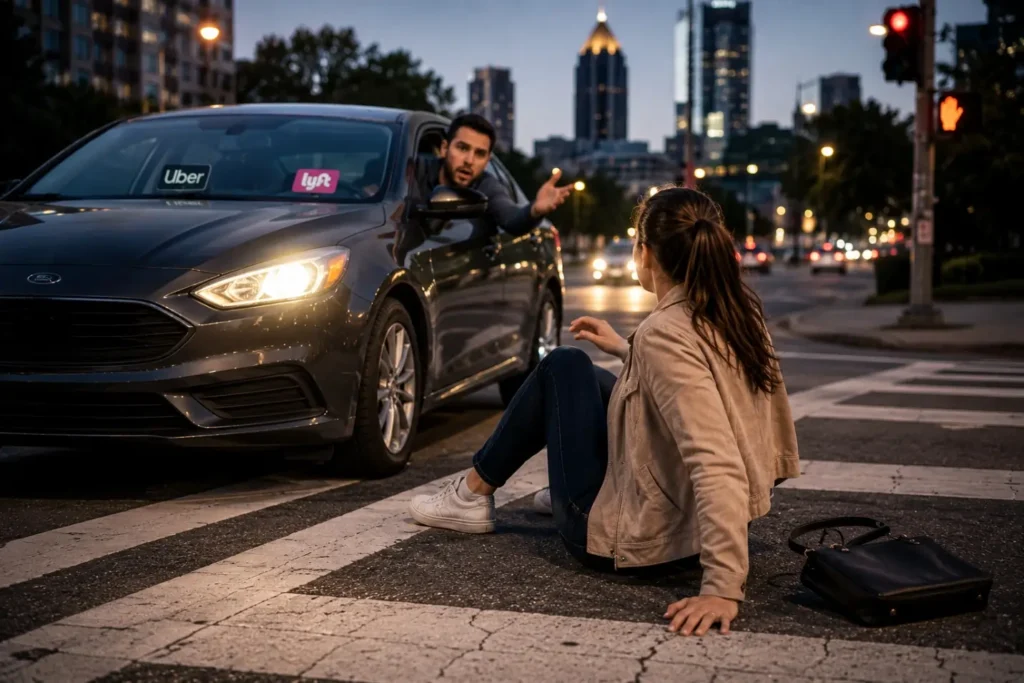
When a pedestrian is struck by an Uber or Lyft driver in Atlanta, the available insurance coverage depends on what the driver was doing in the app at the moment of the crash. If the driver was actively transporting a passenger or en route to a pickup, Uber and Lyft’s $1 million commercial policies apply. If the driver was logged off, only their personal auto policy is available. Georgia law gives you two years to file a claim, but preserving app data, GPS records, and scene evidence must happen quickly.
When a Rideshare Vehicle Becomes a Danger to Pedestrians
Pedestrian safety in Atlanta has become an increasingly urgent issue. The city’s dense urban core, growing population, and the surge in app-based transportation have put more drivers on the road with divided attention, more drop-offs and pickups near busy sidewalks, and more moments where a pedestrian and a rideshare vehicle occupy dangerous proximity.
Being struck by an Uber or Lyft driver is not the same as being hit by a personal vehicle. The liability structure is different. The insurance coverage is different. The legal strategy is different. If you were walking and hit by a rideshare driver in Atlanta or the surrounding Georgia metro area, this guide explains how your case works, who is responsible for your medical bills, and what steps protect your claim.
Why Pedestrian Accidents Involving Rideshare Vehicles Are Different
When you are injured as a passenger in a car accident or as another driver, the path to insurance coverage is relatively predictable. When you are a pedestrian struck by a rideshare vehicle, several things complicate the picture immediately.
First, Uber and Lyft classify their drivers as independent contractors, not employees. This classification is designed to limit the companies’ direct liability. While Georgia courts have increasingly scrutinized this structure, it remains a first-line argument from rideshare insurers.
Second, the insurance coverage that applies to your claim shifts based on a series of operational windows, called periods, defined by what the driver was doing in the app at the exact moment of the crash.
Third, pedestrian injuries from vehicle impacts are frequently serious. Broken bones, traumatic brain injuries, spinal damage, and internal injuries are common outcomes. The medical costs and long-term impact of these cases often far exceed what standard personal injury claims involve.
If the driver who hit you is facing criminal charges, it helps to understand how vehicular homicide charges can affect your family’s civil claim, since the two cases move on separate tracks.
The Three Coverage Periods That Determine Who Pays
Understanding Uber and Lyft’s insurance structure is essential to understanding where your compensation comes from.
Period 0: Driver Is Logged Off
If the driver was not logged into the Uber or Lyft app at the time of the crash, neither company’s commercial insurance applies. You are dealing with the driver’s personal auto policy, which may have only minimum coverage. Georgia requires a minimum liability limit of $25,000 per person, which may be far less than your medical bills. In these situations, your own uninsured or underinsured motorist coverage becomes critically important.
Period 1: Driver Is Logged In but Has No Passenger
This is the most contested period in rideshare insurance cases. The driver is logged into the app and available for rides but has not yet accepted a specific request, or is between completed trips. During Period 1, Uber and Lyft provide contingent liability coverage of $50,000 per person and $100,000 per accident, but only if the driver’s personal policy denies the claim or is insufficient. Many personal auto policies exclude coverage for driving while logged into a rideshare app. When that exclusion applies, the rideshare company’s contingent coverage activates.
Period 2 and 3: Driver Has Accepted a Ride or Has a Passenger
Once a driver accepts a ride request and is en route to a pickup (Period 2), or once the passenger is in the vehicle (Period 3), Uber and Lyft’s full $1 million commercial liability policy applies. This is the coverage tier most people associate with rideshare companies, and it represents substantial protection for seriously injured pedestrians. The challenge is proving which period was active at the moment of the crash. App data, GPS records, and dispatch logs from Uber and Lyft’s internal systems are the evidence that answers this question, and an attorney can compel their disclosure through discovery.
Why Rideshare Drivers Hit Pedestrians in Atlanta
Atlanta’s urban environment creates specific conditions that elevate pedestrian risk from rideshare vehicles.
Drop-Off and Pickup Zones
Uber and Lyft drivers frequently stop suddenly near restaurants, bars, event venues, and office buildings to pick up or drop off passengers. These stops often happen at the curb in areas without designated drop zones, pulling into crosswalks or blocking sightlines for pedestrians. During Atlanta events and summer evenings on the Beltline, Ponce City Market, or Midtown corridors, this dynamic becomes especially dangerous.
App Distraction
Rideshare drivers navigate using the app’s GPS overlay while monitoring incoming ride requests simultaneously. This means a driver is frequently looking at a screen while operating a vehicle in dense urban traffic. App distraction is a recognized and documented cause of rideshare-related crashes, and it is a negligence theory that an attorney can develop with cell phone records and app activity logs.
Unfamiliar Routes and Summer Surge
Summer in Atlanta brings increased rideshare usage during outdoor events, concerts, and festival season. Drivers new to an area rely heavily on GPS navigation, which can cause hesitation, sudden stops, and unexpected turns in areas with significant pedestrian traffic. The combination of high demand, unfamiliar routes, and late-night hours creates conditions where pedestrian accidents become predictable.
Documenting Your Claim After Being Hit by a Rideshare Driver
What you do in the minutes and hours after the crash significantly affects your claim.
Call 911 and do not move unless you must to reach safety. The police report establishes the baseline facts of the crash.
Identify the rideshare vehicle. Photograph the license plate and the Uber or Lyft placard in the windshield. Note whether the driver had a phone mounted and the app running.
Photograph the scene, your injuries, traffic controls, crosswalk markings, and the position of the vehicle.
Get the driver’s name, contact information, and insurance details.
Collect witness information from bystanders who saw the crash.
Seek immediate medical evaluation, even if you feel you can walk. Adrenaline masks serious injuries and delayed medical care creates gaps in your claim.
Do not give a recorded statement to Uber, Lyft, or their insurance adjusters before speaking with an attorney.
Can You Sue Uber or Lyft Directly as a Pedestrian?
Suing Uber or Lyft directly as a corporate entity is possible but legally complex. The companies maintain that their drivers are independent contractors and therefore the companies themselves are not directly liable for the drivers’ negligence. However, several legal theories can bring the companies into the case: negligent hiring and screening, failure to deactivate a driver with a known dangerous history, and the application of Georgia’s agency law principles.
Courts across the country, including in Georgia, have increasingly scrutinized the independent contractor classification as a liability shield. An experienced attorney evaluates whether pursuing the company directly makes sense in your specific case, in addition to the commercial insurance coverage the companies are required to maintain.
How Georgia’s Uninsured Motorist Coverage Protects Pedestrian Victims
If the rideshare driver was in Period 0 with minimal personal coverage, your own uninsured or underinsured motorist coverage may provide an important source of compensation. Georgia law allows pedestrians to claim under their own auto policy’s UM/UIM coverage even when they were not in a vehicle at the time of the crash. This often surprises victims, but it is a significant protection that an attorney will identify and pursue as part of a complete damages analysis.
How KP Law Group Represents Pedestrian Victims of Rideshare Accidents in Atlanta
KP Law Group represents pedestrians injured by rideshare drivers throughout Atlanta, Fulton County, DeKalb County, Cobb County, and the surrounding Georgia metro area. Founding attorney Kristen Pitts, Esq. understands how rideshare insurance structures are designed to complicate and minimize claims, and she fights back with the tenacity these cases require. We obtain the app data, build the full picture of coverage, and pursue every responsible party. If you were hit by an Uber or Lyft driver while walking in Atlanta, you deserve fierce and fearless representation.
Frequently Asked Questions
Q: Who pays my medical bills if I was hit by an Uber driver in Atlanta?
A: It depends on which coverage period was active when the crash occurred. If the driver had a passenger or was en route to a pickup, Uber’s $1 million commercial policy applies. If the driver was logged in but waiting, Uber’s contingent coverage of up to $50,000 per person may apply. If the driver was logged off, you are dealing with the driver’s personal policy. An attorney can quickly determine which period applied by reviewing app and GPS data.
Q: Can I file a claim against Lyft or Uber even as a pedestrian?
A: Yes. Pedestrians are third parties who can make claims against Uber or Lyft’s commercial insurance. You do not need to have been a passenger in the vehicle to access that coverage.
Q: What if the Uber driver fled the scene after hitting me?
A: A hit-and-run by a rideshare driver is still traceable. Uber and Lyft maintain records of every active trip, including the driver’s identity and GPS location at all times. Law enforcement can obtain this information. Your own UM/UIM coverage may also apply in hit-and-run situations.
Q: How long do I have to file a claim after being hit by a Lyft driver in Georgia?
A: Georgia’s general statute of limitations for personal injury claims is two years from the date of the crash. However, rideshare app data that could prove which coverage period was active can be deleted over time. Contact an attorney well before the deadline.
Q: What if I was partially at fault, such as crossing against a signal?
A: Georgia follows a modified comparative fault rule. If you are found less than 50 percent at fault, you can still recover damages reduced by your percentage of fault. Even if you bear some responsibility for the crash, an attorney can help you understand what you can realistically recover.
Hit by an Uber or Lyft driver while walking in Atlanta? Rideshare insurance is complicated. Getting your rights protected is not.
404-551-4727 | Free Case Review
Fierce and Fearless Representation