


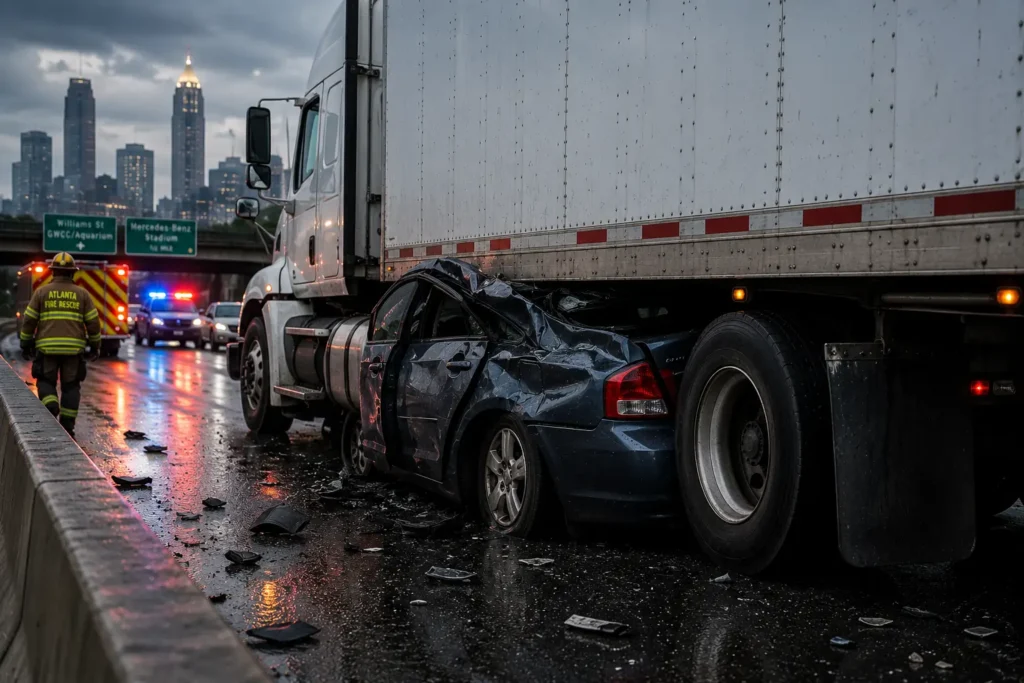
What Is an Underride Truck Accident?
An underride accident occurs when a smaller vehicle, typically a passenger car or SUV, slides under the trailer, side, or rear of a large commercial truck. The collision forces the truck’s undercarriage into the vehicle’s passenger compartment, bypassing the front crumple zone designed to absorb impact energy.
There are two primary types:
Rear underride accidents happen when a passenger vehicle rear-ends a truck and slides beneath the trailer. This is common on Atlanta highways when trucks stop or slow down and vehicles behind them cannot stop in time.
Side underride accidents happen when a passenger vehicle collides with the side of a truck’s trailer during a turn, lane change, or intersection crossing. The vehicle slides under the side of the trailer rather than being deflected.
Both types can be fatal. Both can result in legal claims against multiple parties.
Federal Regulations Require Underride Guards — and Violations Matter
The Federal Motor Carrier Safety Administration (FMCSA) requires commercial trucks to be equipped with underride guards. Rear underride guards, also called rear impact guards, are required on trailers to prevent vehicles from sliding under the back of the truck. Side underride protection, while not universally mandated, is required in certain configurations.
When a trucking company fails to maintain functioning underride guards, or operates equipment that does not meet federal standards, that failure may constitute negligence per se under Georgia law. A violation of a federal safety regulation is not just an equipment issue — it is evidence of legal fault.
Investigators in underride cases examine whether the guard was properly installed, maintained, and capable of stopping a vehicle at highway speeds. Trucking companies sometimes operate with damaged or inadequate guards. When that happens, the legal liability expands significantly.
Why Underride Accidents Happen on Atlanta Roads
Atlanta’s highway system — I-285, I-20, I-75, I-85, and I-675 — sees enormous truck traffic year-round. The combination of congestion, aggressive lane changes, distracted driving, and commercial vehicles operating under tight delivery deadlines creates conditions that lead to underride crashes.
Common causes include:
- Sudden braking by a truck on a congested Atlanta interstate
- Trucks making wide turns at intersections in Fulton County, DeKalb County, and Cobb County
- A truck merging into adjacent lanes without proper signaling
- Inadequate lighting or reflectors on the trailer, particularly in nighttime crashes
- Driver fatigue from hours-of-service violations common in Georgia freight corridors
- Defective or absent underride guards that do not meet federal standards
Summer months see higher truck volume on Georgia’s interstates as consumer goods distribution increases. June, July, and August are historically active months for serious trucking accidents in the Atlanta metro.
Who Is Liable in a Georgia Underride Accident?
Liability often extends well beyond the truck driver alone.
The truck driver may be liable for negligent driving — following too closely, making an unsafe lane change, failing to use signals, or driving while fatigued.
The trucking company may be liable under several legal theories:
- Vicarious liability for the driver’s negligence
- Negligent maintenance if guards were damaged or below federal standards
- Negligent supervision or dispatch if the driver was pushed beyond legal hours of service
- Negligent entrustment if the company knew the driver had a history of unsafe driving
The trailer owner (sometimes different from the trucking company) may be liable if the trailer’s underride guard was defective, improperly installed, or not maintained.
The manufacturer of the underride guard may face a product liability claim if the guard failed due to a design or manufacturing defect.
Georgia’s modified comparative negligence rule means that even if you were partly at fault, you can still recover compensation as long as your fault is less than 50 percent.
What Damages Can Georgia Victims Recover?
Because underride accidents so frequently result in catastrophic injuries, the damages tend to be substantial. Victims and their families may be entitled to recover:
- Medical expenses — past and future, including emergency care, surgeries, rehabilitation, and long-term care
- Lost income — wages lost during recovery and diminished earning capacity going forward
- Pain and suffering — physical pain and the psychological impact of the injuries
- Emotional distress — anxiety, PTSD, and other mental health consequences
- Loss of enjoyment of life — when injuries permanently limit what a victim can do
- Wrongful death damages — if the victim did not survive, their Georgia family may pursue a wrongful death claim
Georgia law generally allows two years from the date of the injury to file a personal injury lawsuit. In wrongful death cases, families typically have two years from the date of death. Do not wait.
Why Underride Cases Require Immediate Action
Evidence disappears fast in serious truck accident cases. In underride cases, the stakes are even higher.
Trucking companies must preserve certain records after an accident — black box data, driver logs, maintenance records, inspection reports, and dispatch communications. However, this obligation is not automatic. It requires a formal legal hold notice sent by an attorney.
The physical evidence — the truck itself, the trailer, and the underride guard — may be repaired or replaced within days of the crash. Once that happens, proving the guard was defective becomes significantly harder.
Engaging an underride truck accident lawyer in Atlanta early means your legal team can send that preservation demand, secure independent experts to inspect the equipment, and build the case before critical evidence is gone.
What To Do After an Atlanta Underride Accident
If you or a family member survived an underride crash in Atlanta, take these steps:
- Get emergency medical care immediately. Internal injuries and brain trauma may not present symptoms right away.
- Do not speak with the trucking company’s insurance representative without an attorney present.
- Preserve everything — photos, medical bills, witness contact information, and any communication from the other party’s insurer.
- Contact an Atlanta truck accident attorney who has handled underride cases specifically.
KP Law Group Handles Atlanta’s Hardest Trucking Cases
At KP Law Group, we represent victims of the most serious trucking accidents in Atlanta and across Fulton, DeKalb, and Cobb Counties. Our approach is fierce, fearless, and focused on holding negligent trucking companies fully accountable — not just the driver, but the company, the equipment owner, and every party whose negligence contributed to the crash.
Underride accidents are not ordinary cases. They require an extraordinary level of preparation, expert partnership, and legal strategy. That is what we bring.
Frequently Asked Questions
1. What is an underride guard, and is a trucking company required to have one?
An underride guard is a metal bar or device installed at the rear or sides of a commercial truck trailer to prevent smaller vehicles from sliding underneath during a collision. Federal FMCSA regulations require rear underride guards on most commercial trailers. When these guards are missing, damaged, or fail to meet federal standards, the trucking company may be held liable under Georgia’s negligence per se doctrine.
2. Can I sue the trucking company if the underride guard failed in Atlanta?
Yes. If an underride guard was defective, improperly maintained, or did not meet federal safety standards, you may have a claim directly against the trucking company and potentially the trailer manufacturer. Georgia allows victims to pursue multiple liable parties in a single lawsuit.
3. How long do I have to file an underride truck accident claim in Georgia?
Georgia’s statute of limitations for personal injury claims is generally two years from the date of the accident. In wrongful death cases, families typically have two years from the date of death. Acting sooner is strongly advised because critical evidence must be preserved immediately.
4. What if the truck driver was not at fault? Can I still recover?
Potentially, yes. Underride accidents often involve equipment failure separate from driver error. If the underride guard was defective or improperly maintained, liability may fall on the trucking company or manufacturer even if the driver operated the vehicle appropriately.
What compensation can an underride accident victim recover in Georgia?
Georgia law allows recovery for medical expenses, lost income, future earning capacity, pain and suffering, emotional distress, and loss of enjoyment of life. In wrongful death cases, families may also recover funeral expenses and the full value of the deceased’s life under Georgia’s wrongful death statute.
CALL TO ACTION
If you or a loved one was injured in an underride truck accident in Atlanta or anywhere in Fulton, DeKalb, or Cobb County, do not wait. The trucking company’s legal team is already working to protect their interests. You deserve fierce and fearless representation that protects yours.
Contact KP Law Group today for a free case review.
404-551-4727 | Free Fierce and Fearless Case Review | thekplawgroup.com