


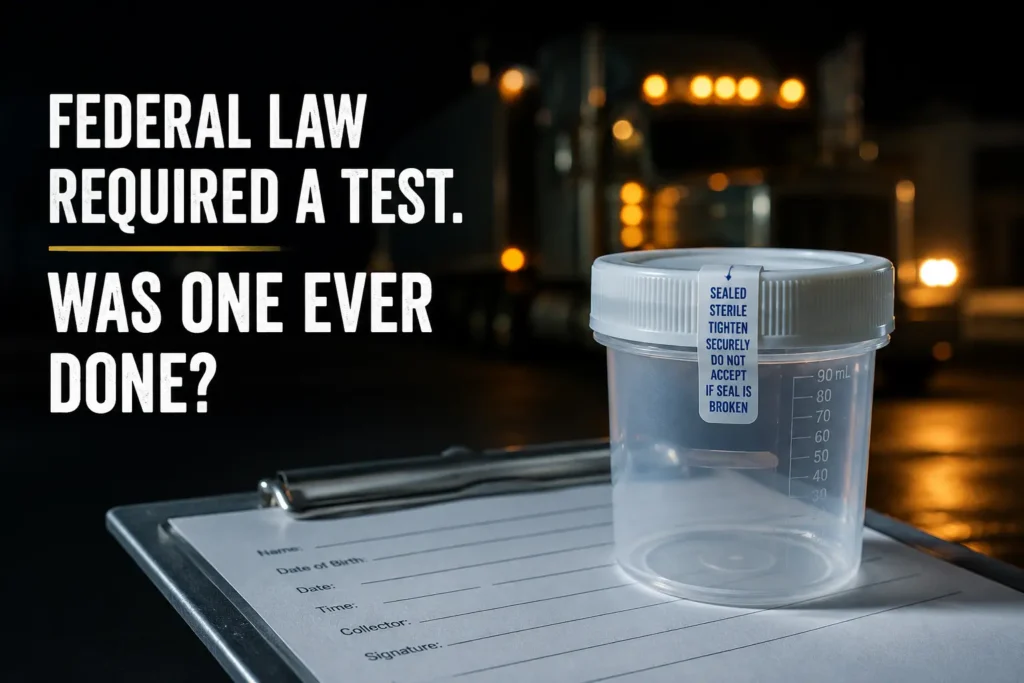
Federal regulations require a commercial truck driver to be tested for drugs and alcohol after certain crashes, including any crash involving a fatality. Alcohol testing should happen within two hours and must be documented if it takes more than eight. Drug testing must occur within 32 hours. When a Georgia trucking company skips the test or cannot explain the delay, that failure itself becomes evidence, and in some cases it supports a claim for punitive damages.
After a serious crash with a commercial truck in Atlanta, one question gets asked far too late: was the driver tested?
Federal law does not leave this to the trucking company’s discretion. Under 49 CFR § 382.303, a truck driver drug test after an accident in Georgia is mandatory in defined situations. When it does not happen, or when the paperwork is missing, that gap can reshape the entire case.
The Three Triggers That Require a Post-Accident Test
Post-accident testing applies to a commercial motor vehicle operating on a public road in commerce. Testing is required when any one of these conditions is met:
- A human fatality results from the crash. The surviving CMV driver must be tested for both drugs and alcohol regardless of fault and regardless of whether any citation was issued.
- Someone involved in the crash needs immediate medical treatment away from the scene, and the CMV driver receives a citation for a moving violation arising from the crash.
- Any vehicle involved sustains disabling damage requiring a tow from the scene, and the CMV driver receives a citation for a moving violation arising from the crash.
The fatality trigger is the important one to understand. It does not depend on fault or on a citation. If someone died, the surviving commercial driver must be tested. Period.
That distinction matters in Georgia wrongful death cases. Trucking companies sometimes argue the driver was not at fault and therefore no test was required. For a fatality crash, that argument is simply wrong under the regulation.
The Clock: Two Hours, Eight Hours, and 32 Hours
Timing is built into the rule because the evidence degrades quickly.
Alcohol testing should be conducted within two hours of the crash. If it is not, the carrier must prepare and keep a written record explaining the delay. If the alcohol test still has not occurred within eight hours, the carrier must stop attempting it and document why it was never administered.
Controlled substance testing must be completed within 32 hours. Again, if it is not, the carrier must document the reason in writing.
Those documentation requirements are quietly one of the most useful tools an Atlanta truck accident attorney has. The regulation creates a paper trail by design. Either the carrier produces the test results, or it produces a written explanation, or it produces nothing at all, and the last option is a problem for the defense.
What Happens When the Test Never Happens
A missing test does not prove the driver was impaired. It does something else that can be nearly as valuable.
First, it establishes a federal safety violation independent of how the crash occurred. That violation speaks to the carrier’s safety culture, which becomes relevant to claims for negligent hiring, training, supervision, and retention.
Second, Georgia law addresses the destruction or loss of evidence a party had a duty to preserve. When a defendant fails to preserve evidence it knew or should have known was relevant to anticipated litigation, courts can impose spoliation sanctions, which may include an instruction allowing the jury to infer the missing evidence would have been unfavorable to the party who lost it. A jury told it may assume the untaken test would have been unfavorable is a very different jury.
Third, it shifts the conversation. The defense wants the trial to be about the seconds before impact. Evidence of regulatory noncompliance widens the frame to the company’s conduct over months and years.
Refusal Counts as a Positive Result
Drivers occasionally refuse a required test. Federal regulations treat a refusal as a verified positive result. The driver must be immediately removed from safety-sensitive duties and referred to a substance abuse professional before any return to duty.
For an injured person in Fulton, DeKalb, or Cobb County, a documented refusal is a substantial fact. It is recorded, it is reportable, and it is difficult for a carrier to minimize.
The Clearinghouse: The Database That Can Expose a Hiring Failure
The FMCSA Drug and Alcohol Clearinghouse launched in January 2020 as a national database of commercial driver drug and alcohol program violations. It records positive test results and refusals to test.
Employers are required to query the Clearinghouse before hiring a CDL driver and annually for current drivers. That requirement creates a clean liability question: did this carrier run the query, and what did it show?
If a carrier hired a driver who already had a Clearinghouse record, or skipped the required query entirely, that is a federal violation and a direct negligence claim against the company itself, separate from any claim based on the driver’s conduct in the crash. It also strengthens the argument that the company, not just the driver, should answer for what happened on a Georgia highway.
How This Affects Punitive Damages in Georgia
Georgia permits punitive damages under O.C.G.A. § 51-12-5.1 in cases showing willful misconduct, malice, wantonness, oppression, or that entire want of care raising the presumption of conscious indifference to consequences.
Ordinary negligence does not get there. A pattern does. Evidence that a carrier ignored a positive test, skipped Clearinghouse queries, put a driver back on the road after a refusal, or systematically failed to conduct required testing can support the argument that the company acted with conscious indifference rather than simple carelessness.
Georgia generally caps punitive damages at $250,000 in many cases, but that cap does not apply where the defendant acted with specific intent to cause harm or was under the influence of alcohol or drugs to the degree that judgment was substantially impaired. Impairment evidence therefore carries weight beyond proving fault.
Why Preservation Letters Have to Go Out Immediately
Test records, dispatch logs, electronic logging device data, driver qualification files, and internal incident reports all sit on retention schedules. Some are routinely overwritten in a matter of weeks.
A spoliation or evidence preservation letter puts the carrier on formal notice of its duty to retain those materials. It should go out well before a lawsuit is filed. Once the duty to preserve attaches, later destruction becomes far harder for a defendant to explain.
For more information, see our guide to truck accident evidence preservation in Atlanta.
What Atlanta Victims Should Do After a Truck Crash
You will not be able to demand a drug test yourself. What you can do is protect the record.
- Get the responding agency’s report number and the names of every officer at the scene.
- Note whether anyone was transported by ambulance and whether any citation was issued.
- Photograph the tractor, the trailer, the DOT number, and any visible damage.
- Write down the carrier name and DOT number, which may differ from the name on the trailer.
- Contact an attorney quickly so preservation letters go out while the records still exist.
Whether a truck driver drug test after an accident in Georgia was performed, delayed, refused, or skipped is one of the first things a serious truck accident investigation should establish. In metro Atlanta, where I-285, I-20, and I-75 carry heavy commercial traffic every day, that question comes up more often than most people realize.
Learn more about your options after a truck accident.
Frequently Asked Questions
1. Is a truck driver always drug tested after an accident in Georgia?
No. Federal regulations require post-accident testing only in three situations: any crash involving a fatality, a crash where someone needs immediate medical treatment away from the scene and the driver is cited for a moving violation, or a crash causing disabling vehicle damage requiring a tow where the driver is cited. In a fatality crash, testing is required regardless of fault or citation.
2. How long does a trucking company have to conduct the test?
Alcohol testing should occur within two hours. If it does not, the carrier must document why, and if eight hours pass the carrier must stop trying and record why no test was given. Controlled substance testing must be completed within 32 hours, with written documentation required for any failure to test in time.
3. What if the trucking company never tested the driver?
A missing test does not prove impairment, but it establishes a federal safety violation and can support a spoliation argument if the company had a duty to preserve that evidence. Georgia courts may allow a jury to draw an unfavorable inference against a party that failed to preserve relevant evidence.
4. Does a refused drug test help my case?
It can. Federal regulations treat a refusal as a verified positive result, requiring immediate removal from safety-sensitive duties and referral to a substance abuse professional. A documented refusal is recorded in the FMCSA Clearinghouse and is difficult for a trucking company to explain away.
5. Can impairment evidence increase what I recover in Georgia?
Potentially. Georgia allows punitive damages under O.C.G.A. § 51-12-5.1 for conduct showing conscious indifference to consequences. Georgia’s general $250,000 punitive cap does not apply when the defendant acted while under the influence of alcohol or drugs to the extent that judgment was substantially impaired.
Call to Action
Trucking companies begin protecting themselves within hours of a crash. You should have someone doing the same for you. KP Law Group moves fast to preserve testing records, driver qualification files, and electronic data before they disappear.
See our case results or contact KP Law Group to discuss your case.
404-551-4727 | Free Fierce and Fearless Case Review