


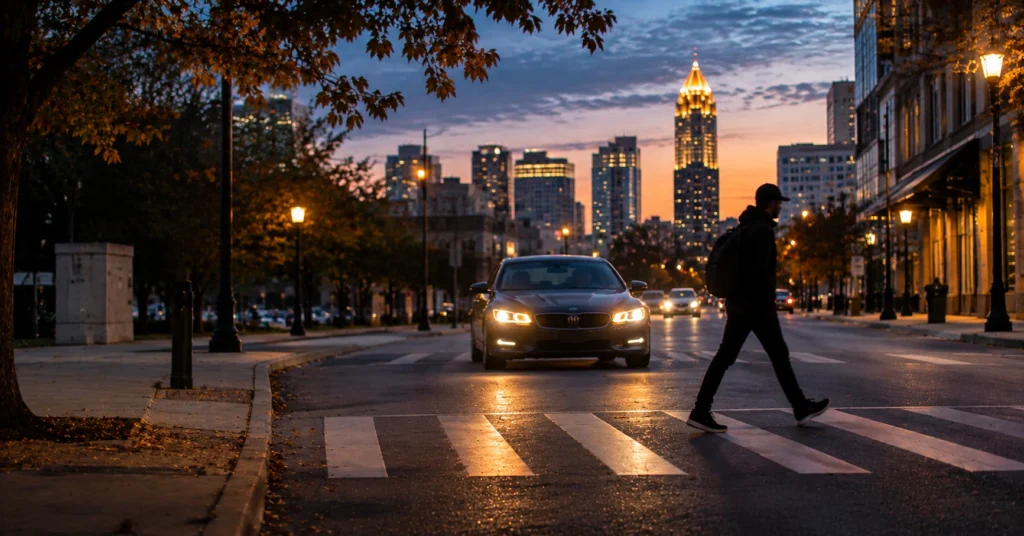
When a driver hits a pedestrian at dusk in Atlanta, fault depends on who had the right of way, whether the driver was paying attention, and whether the walker was visible and using a crosswalk. Georgia uses a 50 percent rule: you can still recover money if you are less than 50 percent at fault, but your award is reduced by your share. You generally have two years to file a lawsuit.
Clocks went back on November 1. Now the sun sets in Atlanta around 5:30 p.m. That means the evening rush hour has moved into the dark. Thousands of people walk home from work, MARTA stops, school, and bus lines right as the light fades.
If you were hit by a car at dusk, you probably have a lot of questions. Was it the driver’s fault? Will the insurance company say you were hard to see? Can you still get paid if you were outside a crosswalk?
This guide answers those questions in plain words. It covers how fault works when a pedestrian is hit by a car at dusk in Atlanta, what Georgia law says, and what to do in the first days after a crash.
Why Dusk Is So Dangerous for Atlanta Pedestrians
Dusk is the hardest time to see. The sky is dim but not dark. Headlights are not yet strong against the glare. Drivers are tired, hungry, and rushing home.
Atlanta adds more risk. Many busy roads were built for cars, not people. Think of Peachtree Road, Memorial Drive, Metropolitan Parkway, and Candler Road in DeKalb County. Some stretches have long gaps between crosswalks and weak street lighting.
Here is what often goes wrong at dusk:
- Drivers look for cars, not people on foot.
- Sun glare and low light hide dark clothing.
- Drivers speed up to beat the light or the traffic.
- Walkers cross mid-block because the next crosswalk is far away.
- Phones pull eyes off the road.
None of this means the walker is to blame. Georgia law puts real duties on drivers, even when it is hard to see.
Georgia Pedestrian Right of Way: What the Law Says
Georgia has clear rules for drivers and walkers. Knowing them helps you see how fault is decided in an Atlanta pedestrian accident.
Crosswalks. Under O.C.G.A. 40-6-91, a driver must stop and stay stopped for a pedestrian in a marked crosswalk. The same rule applies at many unmarked crosswalks at intersections. If a driver hits you in a crosswalk, that driver is usually in a tough spot.
Traffic signals. Under O.C.G.A. 40-6-90, a walker must follow the walk signal. If you started crossing on a walk signal, the driver generally must yield.
Crossing outside a crosswalk. Under O.C.G.A. 40-6-92, a walker outside a crosswalk must yield to cars. This is where insurance companies push hard. But it is not the end of the story.
Driver duty of care. Under O.C.G.A. 40-6-93, every driver must use due care to avoid hitting a pedestrian. That includes sounding the horn when needed. A driver cannot say “I did not see you” and walk away from this duty.
No sidewalk. Under O.C.G.A. 40-6-96, if there is no sidewalk, a walker should stay on the shoulder, facing traffic.
The takeaway: even a walker who crossed in the wrong place can still have a claim if the driver was speeding, distracted, or driving with weak lights.
How Fault Is Decided When It Is Dusk
Fault is rarely all one way. Georgia looks at what each person did. Here are the key questions an adjuster, a lawyer, or a jury will ask.
Was the driver paying attention?
Phone records, dash cams, and witness stories can show a driver was texting or looking away. Georgia’s Hands-Free law bans holding a phone while driving. Proof of phone use can change a case fast.
Was the driver going too fast for the light?
A driver must slow down when visibility is poor. Going the speed limit is not always safe at dusk. “Too fast for conditions” is a common finding.
Was the walker visible?
Reflective clothing, lights, and a lit crosswalk help. But a driver with working headlights should still see a person in a crosswalk. Street light maps and scene photos matter here. Take them early, because the lights may be fixed or changed later.
Where was the walker?
A crosswalk, an intersection, a mid-block crossing, and a spot with no sidewalk all lead to different fault results. Your location is one piece. It is not the whole case.
Georgia’s 50 Percent Rule and Your Pedestrian Claim
Georgia uses modified comparative negligence under O.C.G.A. 51-12-33. In simple terms:
- If you are less than 50 percent at fault, you can still recover money.
- Your award is reduced by your percent of fault.
- If you are 50 percent or more at fault, you recover nothing.
Here is an example. Say a jury finds your damages are $100,000. They decide you were 20 percent at fault for crossing mid-block. You would receive $80,000.
This is why the insurance company will try to shift blame to you. Every point of fault they add lowers what they pay. A strong case pushes back with facts: speed data, video, witness statements, and the driver’s own words.
What To Do After a Dusk Pedestrian Crash in Atlanta
What you do in the first days can shape the whole claim. Follow these steps if you are able.
- Call 911. Ask for police and medical help. A police report is key evidence. Atlanta Police, DeKalb County Police, or Georgia State Patrol may respond depending on the road.
- Get medical care right away. Some injuries, like head trauma and internal bleeding, do not show at first. A medical record also ties your injuries to the crash.
- Photograph everything. Take pictures of the road, the crosswalk, the lighting, the car, and your injuries. Do it before sunrise if you can come back, because lighting changes.
- Get names. Collect the driver’s name, plate, and insurance. Get witness phone numbers.
- Look for cameras. Nearby stores, MARTA stops, traffic poles, and homes may have video. Many systems erase footage in days or weeks.
- Be careful with insurance calls. You do not have to give a recorded statement to the other driver’s insurer. Their goal is to lower the claim.
- Keep your records. Save bills, missed work notes, and photos of healing.
What Your Claim May Cover
Pedestrians often suffer serious harm, since there is no steel around them. A claim may include:
- Medical bills, past and future
- Lost income and lost ability to earn
- Pain and suffering
- Physical therapy and rehab
- Scarring and permanent injury
- In the worst cases, wrongful death for the family
Georgia’s 2025 tort reform law changed some rules about how medical bills and other evidence are shown in court. That makes it more important to have a lawyer who keeps up with current Georgia law.
Deadlines You Cannot Miss
Georgia’s statute of limitations for most personal injury claims is two years from the date of the crash, under O.C.G.A. 9-3-33. Wrongful death claims also generally have a two year limit. Claims against a city or county, such as for a bad road or signal, can have much shorter notice rules. In some cases the notice is due in months, not years.
Waiting makes it harder to find video, keep witnesses, and prove what happened at dusk.
Why Talk to a Pedestrian Accident Lawyer in Atlanta
Pedestrian cases are not like normal car crashes. The facts are often disputed, and the driver’s insurer often claims the walker was hard to see. A good lawyer can:
- Send a preservation letter so video is not erased
- Study the lighting and the scene
- Pull phone and vehicle data
- Deal with insurance adjusters for you
- Add up the full cost of your injuries
- File suit in Fulton, DeKalb, or Cobb County if needed
At KP Law Group, we handle pedestrian accident cases across metro Atlanta. We know the roads, the courts, and the tricks insurers use. If you were hurt walking at dusk, you do not have to prove it all alone.
Frequently Asked Questions
-
Who is at fault if a car hits a pedestrian at dusk in Atlanta?
It depends on the facts. Drivers must use due care and yield in crosswalks under Georgia law. A walker who crosses outside a crosswalk must yield, but a driver who is speeding or distracted can still share the blame. Georgia divides fault by percent.
-
Can I still recover money if I was crossing outside a crosswalk in Georgia?
Often yes. Under O.C.G.A. 51-12-33, you can recover if you are less than 50 percent at fault. Your award is reduced by your share of fault. If you are 50 percent or more at fault, you cannot recover.
-
Does the time change make drivers more at fault for hitting walkers?
The time change does not change the law, but it changes the facts. Drivers must slow down when it is hard to see. A driver who ignores low light and hits a walker may be found negligent.
-
How long do I have to sue after a pedestrian accident in Georgia?
Most personal injury lawsuits must be filed within two years of the crash under O.C.G.A. 9-3-33. Claims against a government body can have much shorter notice deadlines, so speak with a lawyer quickly.
-
What should I do if the driver’s insurance company calls me?
You can be polite and give basic facts, but you do not have to give a recorded statement. Do not accept a quick settlement before you know the full extent of your injuries. Talk to a lawyer first.
Call to Action
Hurt while walking in Atlanta? Do not let an insurance adjuster tell you it was your fault. KP Law Group fights for injured pedestrians across Fulton, DeKalb, and Cobb Counties. Call us today for a free case review. You pay nothing unless we win your case.
404-551-4727 | Free Fierce and Fearless Case Review
See our case results to learn more about the outcomes we have achieved for clients.
If you need help with your pedestrian accident case, contact KP Law Group for a free case review.
You can also learn more about your rights if you were hit by a car on a sidewalk in Georgia or Atlanta.