


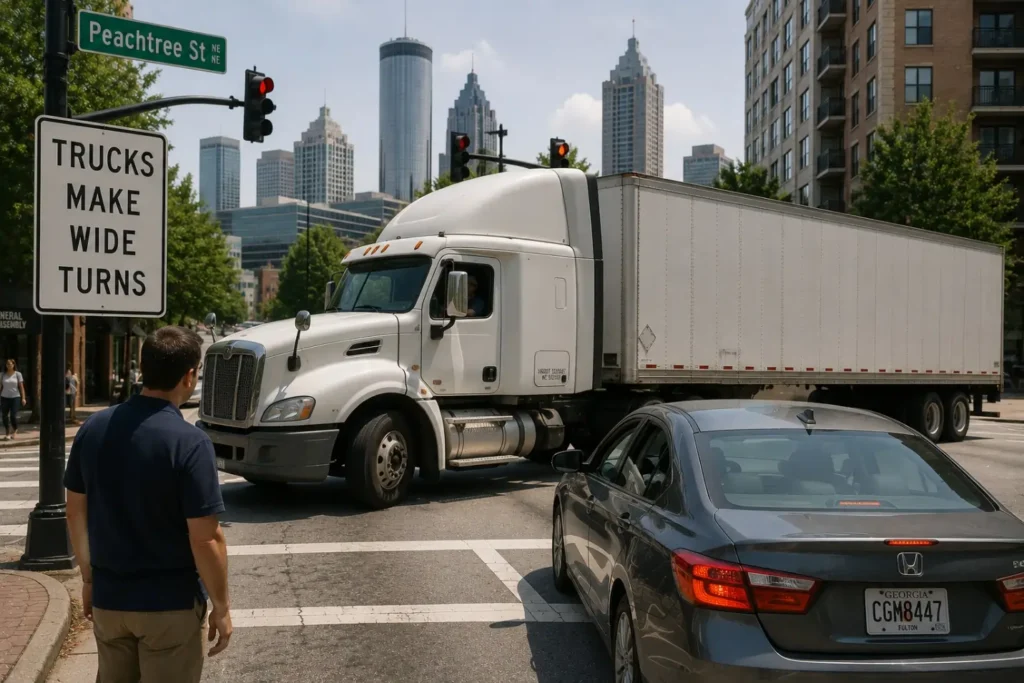
Georgia caps most commercial trucks at 80,000 pounds gross weight, and overweight or improperly loaded cargo is one of the leading causes of jackknife crashes, rollovers, and brake failures on Atlanta highways. When a truck exceeds legal weight limits or its cargo shifts because it was loaded incorrectly, the trucking company, shipper, and loading crew can all share liability. KP Law Group investigates weigh station records, bills of lading, and load manifests to identify every party responsible for your injuries.
Why Overloaded Trucks Are So Dangerous on Atlanta Roads
A fully loaded 18-wheeler already takes 20 to 40 percent longer to stop than a passenger car. Push that truck past its legal weight limit, and stopping distances grow even longer while the risk of tire failure, brake overheating, and rollover climbs sharply. On Atlanta’s busiest freight corridors, including I-285, I-75, and I-20, overweight trucks are a constant and largely invisible hazard until something goes wrong.
Georgia law limits most commercial vehicles to a gross weight of 80,000 pounds, with specific axle weight limits designed to protect roads and control stopping performance. Trucks that exceed these limits without a valid oversize or overweight permit are operating illegally, and that illegal operation often becomes central evidence in a personal injury claim.
Common Ways Overloaded Cargo Causes Atlanta Truck Accidents
Overloading and improper loading create danger in several specific ways:
- Shifted cargo during braking or turning, which throws off the truck’s center of gravity and triggers a rollover
- Excess weight that overwhelms the braking system, causing brake fade or complete brake failure on downhill grades
- Tire blowouts caused by weight exceeding the tire’s rated capacity
- Reduced steering control, making it harder for the driver to avoid a sudden hazard
- Jackknife accidents, where the trailer swings out because weight distribution makes the trailer harder to control during hard braking
Any one of these failures can turn a routine highway trip into a catastrophic, multi-vehicle collision. Atlanta’s dense traffic and frequent lane changes near interchanges like Spaghetti Junction only increase the danger.
Who Can Be Held Liable for an Overweight Truck Accident in Georgia
Overloaded truck cases are rarely limited to the driver. In many claims, KP Law Group identifies liability across several parties:
The Trucking Company
Motor carriers are responsible for ensuring their vehicles comply with federal and Georgia weight regulations. If a company pressured a driver to accept an overweight load to meet a delivery deadline, that decision can support a negligence claim against the carrier directly.
The Shipper or Loading Company
Whoever loaded the trailer has a duty to distribute weight properly and secure cargo according to federal securement standards. A warehouse or distribution center that overloads a trailer or fails to brace freight correctly can be named as a defendant.
The Driver
Commercial drivers are trained to check load weight and are required to inspect their vehicle before departure. A driver who knowingly hauls an overweight load, or who fails to notice an obvious loading problem, may bear personal responsibility alongside the company.
Third-Party Logistics Brokers
In some cases, the broker who arranged the shipment set unrealistic timelines that incentivized overloading. Depending on the broker’s level of control over the load, they may share liability as well.
The Evidence That Wins These Cases
Overloaded truck claims depend on documentation that most accident victims never see. KP Law Group moves quickly to obtain:
- Weigh station and Department of Transportation inspection records
- The truck’s bill of lading and load manifest
- Electronic logging device (ELD) data showing route and stop history
- Maintenance and pre-trip inspection reports
- Photos and measurements from the crash scene showing cargo spillage or shifting
Because trucking companies are only required to preserve certain records for a limited time, sending a spoliation letter within days of the crash is often the difference between a strong case and a lost one. This is one of the first steps our office takes after a truck accident intake.
Georgia’s Statute of Limitations for Truck Accident Claims
Georgia law generally gives injury victims two years from the date of the crash to file a personal injury lawsuit, and wrongful death claims follow the same two-year window in most circumstances. Claims involving government entities, such as a Georgia Department of Transportation vehicle, carry much shorter notice deadlines, sometimes as short as six months. Waiting to speak with an attorney can quietly close doors that were still open the day of the crash.
Comparative Negligence in Georgia Truck Accident Cases
Georgia follows a modified comparative negligence rule. If you are found partially at fault for the crash, your compensation is reduced by your percentage of fault, and you are barred from recovery entirely if you are found 50 percent or more at fault. Trucking companies and their insurers routinely try to shift blame onto the other driver to reduce their payout, which is why building a fact-based case with objective evidence matters from day one.
What to Do After an Overloaded Truck Accident in Atlanta
- Get medical care immediately, even if injuries seem minor at first
- Call police to the scene and request a copy of the official crash report
- Photograph the truck, spilled or shifted cargo, skid marks, and any visible damage
- Avoid giving a recorded statement to the trucking company’s insurer
- Contact a truck accident attorney before evidence is lost or destroyed
FAQ
1. Q: What is the legal weight limit for trucks in Georgia?
A: Most commercial trucks in Georgia are limited to a gross vehicle weight of 80,000 pounds under standard permits, with specific limits per axle group. Trucks exceeding this weight need special overweight permits, and operating without one is a regulatory violation that can support a negligence claim.
2. Q: How do I know if the truck that hit me was overloaded?
A: Weigh station records, DOT inspection reports, and the truck’s bill of lading can confirm whether a load exceeded legal limits. An attorney can subpoena these records before the trucking company is required to destroy them.
3. Q: Can I sue the company that loaded the truck, not just the driver?
A: Yes. Shippers and loading companies have a legal duty to load and secure cargo safely. If improper loading caused or contributed to your crash, the loading company can be held liable alongside the trucking carrier.
4. Q: How long do I have to file a truck accident claim in Georgia?
A: Georgia’s statute of limitations for personal injury claims is generally two years from the date of the accident. Some claims involving government vehicles have much shorter deadlines, so it is important to speak with an attorney as soon as possible.
5. Q: What compensation can I recover after an overloaded truck accident?
A: Depending on the facts of your case, you may be entitled to medical expenses, lost wages, future earning capacity, pain and suffering, and in cases of gross negligence, punitive damages under Georgia law.
Call to Action
An overloaded truck can turn a normal commute into a life-altering event. If you were hurt in a crash involving an overweight or improperly loaded commercial truck in Atlanta, KP Law Group will investigate every party responsible and fight to protect your recovery. Call 404-551-4727 for a free Fierce and Fearless Case Review.