


If your neighbor’s dog bit you in Georgia, you can often bring a claim under O.C.G.A. § 51-2-7, which holds an owner responsible when a dog known to be vicious or dangerous is carelessly managed, or when a leash ordinance is broken. The claim is usually paid by the neighbor’s homeowner’s or renter’s insurance, not out of their pocket. You generally have two years to file, so document the bite, report it, and get medical care right away.
It is one of the hardest calls to make. The dog lives next door. You wave to the owner every morning. Your kids play in the same yard. Then the dog bites you, and now you have to decide what to do.
If your neighbor’s dog bit you in Georgia, you are not alone, and you are not wrong to ask about your rights. Most of these claims are paid by insurance, not by your neighbor’s savings. This guide explains how the law works, what proof you need, and how to protect both your health and your claim.
Can You Sue If Your Neighbor’s Dog Bit You in Georgia?
Yes, in many cases. Georgia does not have a pure “strict liability” dog bite law. Instead, O.C.G.A. § 51-2-7 provides two main paths to hold an owner responsible.
Path 1: The Dog Was Vicious or Dangerous and the Owner Knew It
You can show that the dog was vicious or dangerous, that the owner knew or should have known, and that the owner was careless in managing the dog or allowed it to roam freely. This is often called the “one bite” rule, but a prior bite is not always required. Other signs can count, such as growling at people, lunging at the fence, past complaints, or an animal control report.
Georgia law also addresses how a dog’s dangerousness is established. Learn more about dangerous dog classification in Georgia and how it may affect a bite claim.
Path 2: The Owner Broke a Leash Law
If a local ordinance required the dog to be on a leash or under control, and the dog was loose and bit you, the owner may be liable even without proof that the owner knew the dog was dangerous. A Georgia appeals court has recognized that this route does not require proof of prior knowledge of the dog’s dangerousness when the applicable legal requirements are met (Johnston v. Warendh, 2001).
The City of Atlanta, Fulton County, and DeKalb County have rules concerning dogs running loose and being kept under control. The specific ordinance and circumstances of the bite matter.
For more information, read our guide to off-leash dog attacks and leash laws in Atlanta, Georgia.
Under either path, whether the victim provoked the dog may affect the claim. Ordinary actions such as walking past a dog or being nearby do not automatically establish provocation. The specific circumstances matter, particularly when children are involved.
Common Ways a Neighbor’s Dog Bite Happens
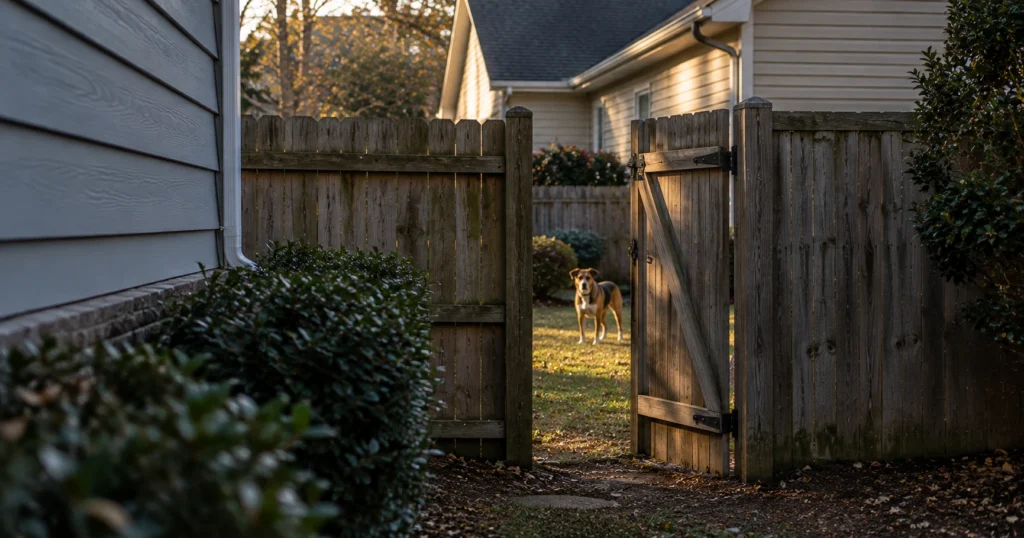
- The dog slips through a gate or a hole in the fence.
- A gate is left unlatched by the owner or a guest.
- The dog jumps or pushes through a fence to reach a walker, a child, or a mail carrier.
- The dog is outside on a long chain or run and bites someone who comes near.
- The dog is off its leash during a walk.
- You were invited into the yard, and the dog was not secured.
Each situation has its own issues. A dog that escaped because of a broken fence the owner knew about may present stronger evidence of careless management than a one-time accident. A dog that bit someone who climbed over a locked fence may present a more difficult case.
Where You Were Matters
Georgia law considers why you were on the property. If you were invited, such as a guest or a neighbor dropping by for a visit, you may have a stronger basis for a claim. If you entered without permission, the law generally provides less protection. Under O.C.G.A. § 51-3-3, a property owner generally owes a trespasser a limited duty not to willfully or wantonly injure them.
If the dog left its yard and bit you on a sidewalk, in the street, or on your own porch, the location does not automatically prevent a claim. Those circumstances may support an argument that the dog was not properly controlled.
Learn more about the legal principles involved in our guide to Georgia dog bite laws and who may be liable for your injuries.
Will Your Neighbor’s Insurance Pay for a Dog Bite?
This is the question that worries most people. In many neighbor dog bite cases, the claim is paid by the owner’s homeowner’s or renter’s insurance policy. Many of these policies include personal liability coverage that may apply to dog bites. Depending on the coverage, your neighbor may not have to pay out of pocket for a covered claim.
There are limits. Some policies exclude certain breeds. Others exclude dogs with a bite history or impose specific coverage restrictions. Some policies also have lower limits for medical payments to others, which may cover certain medical expenses without requiring proof of liability.
If there is no applicable insurance, the claim may need to be pursued against the owner directly, which can make collecting compensation more difficult.
It helps to remember that insurance is often the primary source of payment in a dog bite claim. Your neighbor may feel terrible about what happened, but the insurance company will still evaluate the claim and may dispute liability or the amount of compensation requested.
How to Handle the Neighbor Relationship
Many people avoid making a claim because they do not want a fight with their neighbor. Here is a better way to think about it.
- A claim may be handled through an applicable insurance policy rather than directly against your neighbor’s personal savings.
- You can be kind and still protect your legal rights.
- Medical bills for bites, infections, and scarring can be substantial. You should not assume you must carry those costs alone.
- A lawyer can handle communications about the claim so you do not have to argue with your neighbor.
Do not agree to “just let it go” or accept a private cash settlement before you understand the full extent of your injuries. Dog bites can lead to infections, nerve damage, and scars that become more apparent as the wound heals.
What to Do After Your Neighbor’s Dog Bites You
- Get medical care right away. Clean the wound and tell the doctor it was a dog bite.
- Report the bite to your local animal control agency. In Atlanta and Fulton County, animal services generally handles these reports, while DeKalb County has its own animal services agency.
- Ask for the dog’s rabies vaccination record. Georgia has rules concerning quarantine and follow-up after a bite.
- Take clear photos of the wounds now and as they heal.
- Photograph the fence, gate, and location where the incident happened.
- Get names and phone numbers from anyone who witnessed the bite.
- Write down what you remember, including what the owner said.
- Find out the owner’s insurance company, if you can do so appropriately.
- Avoid giving a recorded statement to the owner’s insurer without first understanding your rights.
What Compensation Can You Seek?
Georgia law may allow dog bite victims to seek compensation for losses caused by the incident, including:
- Emergency care, stitches, surgery, and rabies shots.
- Treatment for infections and related complications.
- Plastic surgery for scars, especially on the face, hands, or arms.
- Therapy for fear, anxiety, and emotional trauma.
- Lost income if you could not work.
- Pain and suffering.
In some cases involving particularly egregious conduct, punitive damages may also be available. These damages are intended to punish certain misconduct rather than simply compensate the victim. Whether they apply depends on the evidence and Georgia law.
Defenses a Neighbor or Insurer May Raise
Expect pushback. Common arguments include that you provoked the dog, that you were trespassing, that the dog never showed signs of danger, or that you share responsibility for the incident.
Georgia’s comparative fault rule (O.C.G.A. § 51-12-33) can reduce your compensation according to your share of fault. If you are found 50 percent or more responsible, you generally cannot recover damages.
Cases involving children can raise additional legal questions because a child’s age and capacity may affect how certain defenses are evaluated. The circumstances of the incident and the available evidence are important.
How Long Do You Have to Act?
The deadline for most Georgia personal injury claims is two years from the date of the bite (O.C.G.A. § 9-3-33). Special rules may apply to claims involving children or other circumstances, so do not assume the deadline is automatically extended.
Even if you have time to file a lawsuit, waiting can hurt your claim. Evidence may disappear, witnesses’ memories can fade, and obtaining cooperation may become more difficult.
If your neighbor’s dog bit you in Georgia, KP Law Group can review the facts, identify potentially applicable insurance coverage, and help you understand your options. We serve people across Atlanta, Fulton County, DeKalb County, and Cobb County. The case review is free.
Visit our contact page to get in touch with our team.
Frequently Asked Questions
1. Can I sue my neighbor if their dog bit me in Georgia?
Often, yes. Under O.C.G.A. § 51-2-7, an owner may be responsible if the dog was vicious or dangerous and the owner knew or should have known about that danger, or if the owner violated an applicable leash or control ordinance and the legal requirements for liability are met. The circumstances of the bite, including possible provocation, matter. In many cases, the owner’s insurance may cover the claim.
2. Does a neighbor’s homeowner’s insurance cover a dog bite?
Many homeowner’s and renter’s insurance policies include personal liability coverage that may apply to dog bites. However, some policies exclude certain breeds, dogs with a known bite history, or particular types of incidents. Coverage limits and exclusions vary, so the policy should be reviewed.
3. What if the dog got out through a broken fence or open gate?
That fact may help your claim. If the owner knew about a broken fence or regularly left a gate open, it may support an argument that the dog was carelessly managed. If a local leash or control ordinance was violated, the owner may also be liable without proof that the owner knew the dog was dangerous, provided the other legal requirements are met.
4. Do I have to report a dog bite from a neighbor’s dog?
You should report it to your local animal control agency. Reporting creates an official record and helps initiate any necessary rabies-related follow-up. In Atlanta and Fulton County, animal services generally handles these reports, while DeKalb County has its own agency.
5. How long do I have to file a dog bite claim in Georgia?
Most Georgia personal injury claims must be filed within two years of the bite (O.C.G.A. § 9-3-33). Different rules may apply to children and certain other situations. Acting promptly can help preserve evidence and protect your claim.
Bitten by a Neighbor’s Dog?
Let KP Law Group help you understand your legal options and deal with the insurance company while you focus on healing. Our team will review your case for free.
Call 404-551-4727 today for a Free, Fierce and Fearless Case Review.