


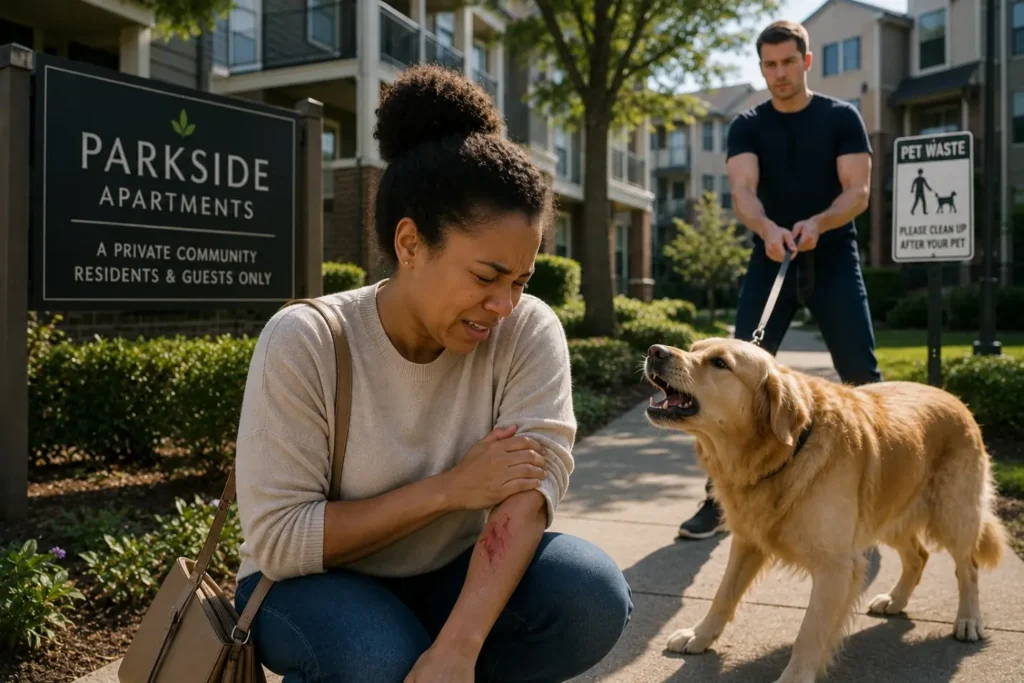
When a dog bites you at an Atlanta apartment complex or HOA community, the dog’s owner may not be the only party liable. Property managers, landlords, and homeowners associations can be held responsible under Georgia law if they knew about a dangerous dog and failed to act. An experienced Atlanta dog bite attorney can identify all responsible parties and help you recover full compensation.
Dog Bites Don’t Only Happen in Private Backyards
Many dog attacks in Atlanta happen on shared property, including apartment complexes, condominium communities, and HOA-governed neighborhoods. When that happens, the pool of responsible parties expands beyond just the dog’s owner. If you were bitten at an Atlanta apartment complex or HOA community, you may have claims against the dog owner, the property manager, the management company, and potentially the HOA itself.
Georgia Dog Bite Law: The Foundation
Georgia dog bite cases start with O.C.G.A. § 51-2-7, which holds dog owners liable when the owner knew the dog had vicious tendencies, or when the owner violated a local leash ordinance and that violation caused the attack. Atlanta, Fulton County, DeKalb County, and Cobb County all have leash laws governing shared spaces in apartment complexes and HOA communities.
When a Landlord or Property Manager Is Liable
Under O.C.G.A. § 44-7-14, Georgia landlords generally are not liable for tenant conduct after transferring possession. But this protection has limits. Landlords and property management companies can face liability when:
They Knew About the Dangerous Dog
If a property manager received complaints about a tenant’s aggressive dog or had knowledge of prior incidents and did nothing, that knowledge changes the legal equation.
They Had Authority to Act
Landlords who include pet policies in leases or who have legal authority to require tenant compliance with pet rules can be held responsible when they fail to enforce those rules.
Their Negligence Created the Conditions for Attack
This includes failing to repair broken gates, inadequate fencing around common areas, poorly lit walkways, and other property maintenance failures that allowed the attack to happen.
When an HOA Can Be Held Liable
HOAs are responsible for maintaining common areas, enforcing community covenants, and keeping shared spaces safe. An HOA may share liability when:
- The attack happened in a common area such as a pool, clubhouse, walking trail, park, or parking lot.
- The HOA had knowledge of a dangerous dog but failed to act under its enforcement authority.
- The HOA failed to enforce its own rules, such as leash requirements or breed restrictions in common areas.
Real Scenarios Where Multi-Party Liability Applies
Scenario 1: Midtown Atlanta Apartment Complex
A dog owned by a tenant attacks a visitor in the parking lot. The property manager had received two prior complaints about that dog. Both the owner and the property management company may be liable.
Scenario 2: HOA-Managed Playground in Smyrna
A dog bites a child at an HOA playground. The HOA’s own covenants required dogs to be on leash in common areas, and the HOA had received complaints about this specific dog. Both the owner and the HOA may be liable.
Scenario 3: Broken Gate in Decatur
A dog escapes through a broken gate in a rental property courtyard that the tenant had reported to management three weeks earlier. Both the owner and the landlord may be liable for the dangerous condition.
In all three scenarios, pursuing only the dog owner may leave significant compensation on the table.
What Damages Are Available?
Georgia law allows recovery for medical expenses, future medical costs, lost wages, pain and suffering, scarring and disfigurement, emotional distress, and punitive damages in cases of extreme negligence. Property managers and HOAs typically carry general liability insurance policies with significantly larger coverage limits than the dog owner’s personal policy. Learn more about dog bite homeowners insurance coverage in Georgia.
Evidence That Matters in These Cases
- Maintenance records showing prior complaints about broken gates or inadequate barriers.
- Prior incident reports from animal control, the HOA, or other tenants.
- Lease agreements and HOA covenants showing whether pet policies were being enforced.
- Email and communication records between tenants, property managers, and HOA boards.
- Surveillance footage from apartment complex or HOA common area cameras.
Steps to Take After a Dog Bite at an Atlanta Apartment or HOA
- Get immediate medical attention and document all treatment.
- Report the attack to Atlanta Animal Control or the relevant county authority.
- Report the incident to property management or the HOA in writing.
- Photograph the dog, the location, your injuries, and any property conditions that contributed.
- Get contact information from any witnesses.
- Do not give a recorded statement to the property manager’s insurance company without legal counsel.
- Contact KP Law Group for a full investigation identifying all liable parties.
Frequently Asked Questions
-
Can I sue my apartment’s property manager if their tenant’s dog bit me?
Potentially yes. Under Georgia law, landlords who have knowledge of a dangerous dog and the authority to require its removal can be held liable for failing to act.
-
What if the dog bite happened in an HOA common area?
HOAs are responsible for keeping common areas safe. If the HOA knew about a dangerous dog, had enforcement authority under its covenants, and failed to act, it may be liable under Georgia premises liability law.
-
Does the apartment complex’s insurance cover dog bite injuries?
Apartment complexes and HOAs typically carry general liability insurance that may cover injuries in common areas. Their policies may provide additional coverage beyond the dog owner’s personal policy.
-
How do I prove the property manager knew about the dangerous dog?
Your attorney can request maintenance records, prior incident reports, email correspondence, and HOA meeting minutes. Animal control records are also a key source of prior complaint documentation.
-
How long do I have to file in Georgia?
Generally two years from the date of the attack for adults. For children, the statute of limitations does not begin until they turn 18. Act promptly because surveillance footage and maintenance records can be lost or destroyed.
Call to Action
Dog bites at apartment complexes and HOA communities involve multiple responsible parties. You deserve a legal team that knows how to find them all.
Call KP Law Group for a FREE case review: 404-551-4727
Fierce and Fearless Representation for Atlanta Dog Bite Victims