


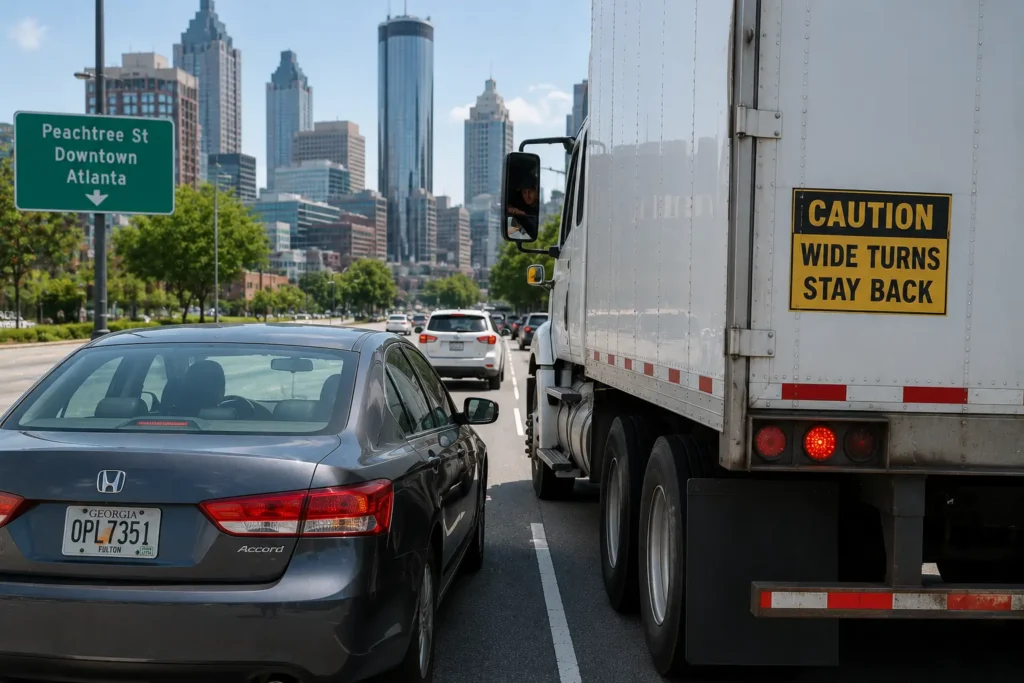
What Are Truck Blind Spots, and Why Are They So Large?
Unlike passenger vehicles, which have relatively small blind spots, commercial semi-trucks have no-zones spanning the entire driver side, the passenger side extending for multiple lanes, the area directly behind the trailer, and the area immediately in front of the cab.
The Federal Motor Carrier Safety Administration recognizes four primary no-zones:
Front No-Zone
The area directly in front of the truck cab, roughly 20 feet ahead, where the driver’s downward visibility is blocked by the height of the cab. A vehicle that merges in front of a truck without enough clearance may be completely invisible to the driver.
Rear No-Zone
Commercial trucks have no rear window and rely entirely on mirrors. The area behind the trailer for approximately 30 feet is completely invisible to the driver, making rear-end crashes a serious risk when vehicles stop or slow behind a truck.
Driver Side No-Zone
This blind spot extends approximately one lane to the left, from the cab back to the front of the trailer. A vehicle traveling in this zone alongside a truck may be partially or completely invisible to the driver.
Passenger Side No-Zone
This is the most dangerous no-zone. It extends from the passenger door backward and outward for approximately two full lanes, covering the entire right side of the trailer. Vehicles in this zone are almost entirely invisible to the truck driver.
How Blind Spot Truck Accidents Happen on Atlanta Roads
Blind spot crashes on Atlanta highways including I-285, I-75, I-85, and I-20 typically follow predictable patterns:
- A truck driver initiates a lane change without fully clearing the blind spot, merging directly into a passenger vehicle traveling alongside
- A truck making a wide right turn swings left before turning, crushing vehicles that have moved up on the passenger side
- A truck merging onto a highway fails to account for vehicles already in the travel lane alongside the trailer
- A vehicle attempts to pass a truck and lingers in the no-zone, then gets struck when the truck moves
- A car following too closely behind a truck enters the rear no-zone and is invisible when the truck brakes suddenly
Who Is Liable in a Georgia Blind Spot Truck Accident?
Georgia law allows victims of blind spot truck accidents to pursue claims against multiple parties. Liability in these cases is rarely limited to just the driver.
The Truck Driver
A commercial truck driver has a professional obligation under Georgia law and federal regulations to check mirrors, signal in advance, and ensure the lane is clear before changing direction. Failure to do so may be considered negligence.
The Trucking Company
Under the legal doctrine of respondeat superior, a trucking carrier is typically liable for the negligent acts of its drivers while operating on company business.
Trucking companies may also face independent liability for negligent training, failure to maintain safety equipment, failure to require inspections, or pressuring drivers to meet unrealistic schedules that contribute to unsafe driving.
Equipment Manufacturers
If a truck’s mirrors, blind spot detection systems, or cameras were defective and contributed to the crash, the manufacturer of those components may also bear liability under Georgia product liability law.
How Georgia Law and Federal Regulations Govern Truck Blind Spots
The Federal Motor Carrier Safety Administration sets specific standards for commercial truck mirrors, requiring that they provide adequate visibility around the vehicle. Violations of these standards can be used as evidence of negligence in an Atlanta truck accident claim.
Georgia’s two-year statute of limitations for personal injury claims applies to trucking accident cases. However, critical evidence including truck camera footage, GPS data, driver logs, and electronic control module data may only be preserved for a limited time.
The Role of Modern Technology in Blind Spot Truck Accident Cases
Many modern commercial trucks are equipped with forward-facing and side-facing cameras, lane departure warning systems, and proximity sensors designed specifically to reduce blind spot crashes.
When a truck equipped with these safety systems is involved in a blind spot collision, failure to maintain or use these technologies can become important evidence of negligence.
What Compensation Can Atlanta Blind Spot Truck Accident Victims Recover?
Blind spot truck accident injuries are frequently severe because of the size difference between commercial trucks and passenger vehicles. Victims in Georgia may be entitled to recover:
- All past and future medical expenses including emergency care, surgery, rehabilitation, and long-term care
- Lost wages and reduced future earning capacity
- Pain and suffering and emotional distress
- Property damage
- Punitive damages in cases involving extreme or reckless carrier misconduct
These cases often involve significant insurance coverage because commercial trucking carriers are required to carry larger liability policies than standard automobile insurance.
Why You Need an Atlanta Trucking Accident Lawyer
Trucking companies and their insurers have experienced legal teams that begin building their defense immediately after a crash. Victims need representation that can quickly preserve evidence, investigate the accident, and build a strong claim.
An experienced Atlanta trucking accident lawyer can help obtain truck company records, work with accident reconstruction specialists, preserve electronic evidence, and pursue the full compensation available under Georgia law.
FAQ
1. How do I know if I was in a truck’s blind spot during my accident?
If the truck moved into your lane and struck you without warning while you were traveling alongside or slightly behind the cab, you may have been in the no-zone. Accident reconstruction experts can analyze crash data, impact points, and vehicle positions to determine what happened.
2. Can I sue the trucking company even if the driver claims they checked their mirrors?
Yes. Truck camera footage, electronic data, and witness testimony may contradict driver statements. You may also pursue claims against the carrier for issues such as negligent training or failure to maintain safety systems.
3. What if I was also partially at fault for the blind spot accident?
Georgia follows a modified comparative negligence rule. If you are less than 50 percent responsible for the crash, you may still recover compensation, though your recovery will be reduced by your percentage of fault.
4. How long do I have to file a truck accident claim in Georgia?
Generally, you have two years from the date of the accident. However, important truck accident evidence may be lost or overwritten quickly, so contacting an attorney early is important.
5. What is the minimum insurance coverage for commercial trucks in Georgia?
Federal law requires most commercial carriers to carry substantial liability coverage depending on the type of cargo and vehicle. This means there is often significant insurance available for serious injuries and fatalities in truck accident cases.
CALL TO ACTION
If you were injured in a blind spot truck accident in Atlanta or anywhere in Georgia, do not wait. Evidence disappears fast in trucking cases. KP Law Group is ready to act immediately to preserve your rights and fight for the full compensation you deserve.
404-551-4727 | Free Fierce and Fearless Case Review