



If you were hurt in a motorcycle crash in Atlanta, you may be worried that the helmet question will sink your case. It usually won’t. The Georgia motorcycle helmet law requires every rider and passenger to wear approved headgear, but a missing helmet doesn’t erase the other driver’s fault. It can affect how much you recover, not whether you can file.
Some insurers use the helmet issue to push low offers. This guide explains what Georgia law requires, how fault is split, the rules riders often get blamed for breaking, and the deadline you can’t miss.
Quick answer
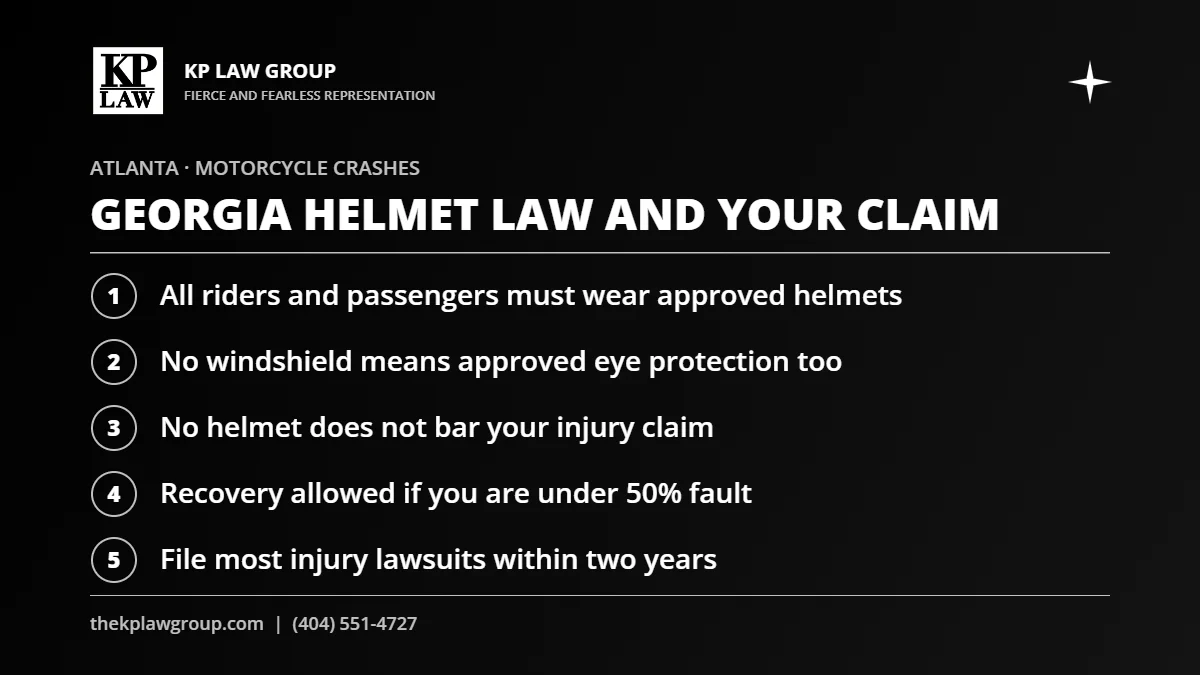
- Georgia requires approved helmets for all riders and passengers, plus eye protection on bikes without a windshield.
- Riding without a helmet does not bar your claim, but an insurer may argue it made a head injury worse and try to cut your damages.
- You can recover as long as you’re less than 50% at fault, and most injury lawsuits must be filed within two years.
What Does the Georgia Motorcycle Helmet Law Require?
Georgia has a universal helmet law. Under O.C.G.A. 40-6-315, no one may operate or ride on a motorcycle unless they’re wearing protective headgear that meets the standards set by the state commissioner of public safety. That covers the operator and the passenger. Age and experience don’t matter.
Eye protection and the windshield rule
The same statute has a second rule that many riders forget. If your motorcycle has no windshield, you must also wear an eye-protective device of a type the commissioner approves. So a rider on a bike without a windscreen needs both a helmet and approved eye protection to be fully compliant.
Who is exempt
The law doesn’t apply to people riding in an enclosed cab or a motorized cart. It also exempts operators of three-wheeled motorcycles used only for farm purposes. The commissioner approves helmets and eye protection, writes the standards and publishes lists of approved products.
Why does this matter for a claim? The insurer will check every piece of gear you wore that day. Knowing exactly what the law says helps you push back when an adjuster overstates it.
Why Helmets Matter: What the Crash Numbers Show
Riders face far more risk than people in cars. According to NHTSA’s motorcycle traffic safety facts for 2022, 6,218 motorcyclists were killed nationwide that year, about 15 percent of all traffic deaths. Per mile traveled, the motorcyclist fatality rate was almost 22 times the rate for passenger car occupants.
Georgia sees its share of those losses. The same NHTSA report shows 221 motorcyclists killed in Georgia in 2022. Of the riders whose helmet use was known, 88 percent were wearing helmets. In other words, most riders killed on Georgia roads were following the helmet law.
Helmets still make a real difference. The IIHS motorcycle fatality facts say helmets are about 37 percent effective at preventing deaths and about 67 percent effective at preventing brain injuries. The CDC’s motorcycle safety page calls universal helmet laws an effective way to save lives.
When a crash is fatal, the family may have a separate claim. Our page on wrongful death claims in Georgia explains who can bring one and what it covers.
Can I Still Get Compensation If I Wasn’t Wearing a Helmet in Georgia?
Yes, in many cases you can. Not wearing a helmet breaks the helmet law, but it didn’t cause the crash. The driver who turned in front of you is still responsible for the collision. Georgia lets you recover as long as you’re less than 50 percent at fault, though your award may be reduced.
How Georgia splits fault
Georgia uses a modified comparative fault rule found in O.C.G.A. 51-12-33. If you’re partly to blame, a jury assigns you a percentage of fault and the judge cuts your damages by that share. If you’re found 50 percent or more responsible, you recover nothing.
Say a jury finds your damages are $200,000 and finds you 20 percent at fault. You may receive $160,000. If the jury put you at 50 percent, you’d get zero. That’s why every percentage point matters, and why insurers fight so hard over fault.
What the insurer will argue
The defense usually doesn’t claim your missing helmet caused the crash. It claims your missing helmet made your injuries worse. That argument only makes sense for some injuries. A helmet doesn’t protect a broken leg, a crushed hand or road rash on your back. If your injuries are below the neck, the helmet issue may have little to do with your damages at all.
How the Georgia Motorcycle Helmet Law Can Change Your Claim’s Value
The helmet question is really a medical question. The insurer has to connect a specific injury to the lack of a helmet. Doctors and crash reconstruction engineers often look at where the impact hit, how fast you were going and what parts of your body took the force.
Think about three common situations:
- You wore a compliant helmet. The helmet law gives the insurer nothing to argue.
- You had no helmet but hurt your legs, hips or spine. The insurer may still raise the helmet, but it has a weak link to those injuries.
- You had no helmet and suffered a head injury. This is where the fight happens. The defense may say a helmet would have prevented or lessened the harm, and it may push to assign you a bigger share of fault.
Head and spinal injuries are some of the costliest outcomes after a crash. They can mean years of care, lost income and changes to your whole family’s life. To see how these cases are valued, read our guide to brain and spinal cord injury settlements in Georgia.
Lane Splitting Is Illegal in Georgia: Other Rules That Affect Fault
The helmet law isn’t the only rule an insurer will check. Georgia has motorcycle-specific traffic rules in O.C.G.A. 40-6-312, and breaking them can shift fault onto you.
- No lane splitting. You may not ride between lanes of traffic or between rows of vehicles. Filtering through stopped traffic on an Atlanta interstate counts.
- No passing in the same lane. To pass a car, you must change lanes.
- No more than two abreast. Only two motorcycles may share a lane side by side.
- Lights on. Your headlight and taillight must be on at all times.
The law also protects riders. Motorcycles are entitled to the full width of a lane, and other drivers may not crowd you out of it. A car that squeezes into your lane to pass you may be breaking the law.
If you were lane splitting when you were hit, your claim isn’t automatically over. A jury still compares everyone’s conduct, but expect the insurer to push hard toward that 50 percent line.
Left-Turn Crashes and Bias Against Riders in Atlanta
One crash pattern shows up again and again. NHTSA found that in 2022, in 44 percent of fatal two-vehicle crashes involving a motorcycle, the other vehicle was turning left while the motorcycle was going straight, passing or overtaking. Drivers often say, “I never saw him.” That isn’t a defense. Under Georgia’s left-turn yield rule, O.C.G.A. 40-6-71, a driver turning left must yield to vehicles coming from the opposite direction that are in the intersection or close enough to be a hazard. Motorcycles are vehicles too.
Other common causes include drivers changing lanes into a rider’s blind spot, rear-end crashes at stoplights and car doors opening into traffic.
The bias problem
Many people assume riders are reckless. Adjusters know that, and jurors can bring the same view into the courtroom. A helmet issue can feed that bias even when it has nothing to do with the crash. That’s one reason motorcycle claims are handled differently. Our article on why motorcycle cases differ from car accident cases walks through those challenges.
The best answer to bias is evidence. Witness statements, traffic camera or dashcam video, photos of the scene and the police report can show what really happened.
What to Do After an Atlanta Motorcycle Crash
The steps you take in the first days can protect your claim:
- Call 911 and get medical care right away, even if you feel fine. Some injuries don’t show symptoms right away.
- Ask for a police report and write down the report number.
- Take photos of the vehicles, the road, your gear and your injuries.
- Get names and phone numbers of witnesses.
- Keep your helmet, jacket and other gear exactly as they are.
- Don’t give a recorded statement to the other driver’s insurer before getting advice.
- Talk with a lawyer well before the filing deadline.
Georgia gives you limited time. Under O.C.G.A. 9-3-33, actions for injuries to the person must be brought within two years after the right of action accrues. Waiting too long can end your case no matter how strong it is.
| Georgia law | What it says | What it means for you |
|---|---|---|
| O.C.G.A. 40-6-315 | Helmet for all riders, eye protection if no windshield | Gear may be questioned in your claim |
| O.C.G.A. 40-6-312 | No lane splitting, full lane use for motorcycles | Breaking it may add fault, crowding you may add fault to the driver |
| O.C.G.A. 51-12-33 | Damages reduced by your share of fault, barred at 50% | You can recover if you’re less than half at fault |
| O.C.G.A. 9-3-33 | Two years to file most injury lawsuits | Act early to protect your rights |
To learn more about how we handle these cases, visit our Atlanta motorcycle accident practice page.
Riding this winter? Read fault after a black ice crash in Georgia.
Frequently Asked Questions
Is it illegal to ride a motorcycle without a helmet in Georgia?
Yes. Georgia has a universal helmet law that requires every motorcycle operator and passenger to wear approved protective headgear. Riders on bikes without a windshield must also wear approved eye protection. Limited exemptions apply to people in enclosed cabs or motorized carts and to three-wheeled motorcycles used only for farm work.
Can I sue if I wasn’t wearing a helmet in a Georgia motorcycle crash?
Yes, in many cases. Not wearing a helmet doesn’t cause a crash, so the driver who caused it can still be held responsible. The insurer may argue your injuries were worse without a helmet and try to reduce your damages. You can recover as long as you’re found less than 50 percent at fault.
Is lane splitting legal in Georgia?
No. Georgia law bars motorcyclists from riding between lanes of traffic or between rows of vehicles. If you were lane splitting during a crash, an insurer will likely argue you share the blame, but you may still recover if your share of fault stays under 50 percent.
How long do I have to file a motorcycle accident claim in Georgia?
Most personal injury lawsuits in Georgia must be filed within two years after the right of action accrues. Missing that deadline can end your case. Video and witness memories also fade fast, so it’s wise to get advice early rather than waiting until the deadline is close.
Who is at fault when a car turns left in front of a motorcycle?
In many cases, the left-turning driver is at fault, because drivers turning left must yield to oncoming traffic, including motorcycles. Left-turn crashes are one of the most common deadly motorcycle crash types. The insurer may still try to blame the rider’s speed or visibility, so scene photos and witness statements matter.
Talk With an Atlanta Motorcycle Accident Lawyer About Your Claim
If an insurer is using the Georgia helmet law against you, you don’t have to accept its version of the story. KP Law Group helps injured riders across Atlanta look at the real cause of the crash, the real source of each injury and what the claim may be worth.
Call (404) 551-4727 or request your free consultation online. There’s no cost to talk with us about your case. Hablamos Español.
This article is general information, not legal advice. Reading it does not create an attorney-client relationship. Every case is different. Talk with a lawyer about your situation.