



When roads freeze in Atlanta, crashes pile up fast. A thin glaze on a bridge or an exit ramp can send cars spinning before drivers even see it. If you were hurt in a black ice car accident in Georgia, the big question is usually simple: who pays? The short answer is that ice alone rarely ends the conversation. Georgia law expects drivers to slow down and leave more room when the weather turns. A driver who didn’t do that may be at fault, even if ice was on the road. In some cases, a city, county or the state may share blame too.
Quick answer
- “The ice did it” is not a full defense. Georgia drivers must drive at a speed that is reasonable for the weather and road conditions.
- Fault can be shared. Under Georgia law, you can still recover if you’re less than 50 percent at fault, but your award shrinks by your share.
- Claims against a city, county or the state have short notice deadlines (as short as 6 months), on top of the 2-year deadline to sue.
Who Is at Fault in a Black Ice Car Accident in Georgia?
Fault in a black ice car accident in Georgia usually lands on the driver who failed to adjust to the conditions. Ice is a hazard, not an excuse. Georgia courts and insurers ask whether a careful driver, facing the same road, would have slowed down, braked earlier or kept more distance.
Picture a cold morning on I-285. The road looks wet, but parts of it are frozen. One driver slows and leaves a long gap. Another keeps going 65 mph and rides the bumper ahead. When traffic slows, the second driver slides into the first. The ice played a role, but the second driver’s choices caused the crash.
When ice really is the main cause
Sometimes a driver did everything right and still lost control. In those cases, the claim may shift to other parties, such as a government agency that ignored a known problem, or a trucking company whose driver created a hazard.
Georgia Law Says Drive for the Conditions, Not the Speed Limit
Georgia’s basic speed rule is the heart of most icy road claims. Under O.C.G.A. 40-6-180, Georgia’s basic speed rule, no one may drive “at a speed greater than is reasonable and prudent under the conditions.” The statute also says drivers must use an appropriate reduced speed when special hazards exist “by reason of weather or highway conditions.”
In plain terms, the posted limit is a ceiling for good weather, not a safe speed on ice. A driver can be 10 mph under the limit and still be too fast for a frozen overpass. The Georgia Department of Transportation goes further. Its GDOT winter weather guidance tells drivers to “SLOW DOWN to at least half of the normal speed limit” in wintry conditions.
Following too closely on ice
Georgia’s following too closely law, O.C.G.A. 40-6-49, says a driver “shall not follow another vehicle more closely than is reasonable and prudent.” On ice, stopping takes much longer, so a gap that’s fine on a dry day can be far too short. If someone slid into the back of your car on an icy morning, this law is often central to the claim.
Our page on Atlanta car accident claims explains how these rules fit into a full claim.
Why Bridges and Overpasses Freeze First
Cold air moves above and below a bridge deck, so it loses heat faster than road on solid ground. A bridge can ice over while the road leading up to it is only wet.
GDOT warns about this directly. Its winter weather page tells drivers to “Beware of black ice (especially on bridges and overpasses).” It also describes black ice as “a thin, often invisible sheet of ice that forms on the roadway.” Black ice is hard to see, but the fact that bridges freeze first is widely known, and GDOT says so in public warnings. That can matter in a fault fight. A driver who speeds onto an overpass during a freeze may have a hard time arguing the ice was a surprise.
Metro Atlanta has plenty of elevated roadway, from interchanges and ramps along I-285 and I-85 to small bridges over creeks. If your crash happened on a bridge or ramp, note it and take photos if you safely can.
How common are weather crashes?
Weather crashes aren’t rare. The Federal Highway Administration’s road weather data estimates about 744,911 weather-related crashes a year nationwide (2019 to 2023 averages), about 12 percent of all crashes. Of those, it estimates 219,942 crashes a year happen during freezing precipitation such as snow, sleet and freezing rain.
Shared Fault in Icy Road Crashes Under Georgia Law
Insurers may argue you were also going too fast. Georgia handles this with a shared fault rule.
Under Georgia’s apportionment statute, O.C.G.A. 51-12-33, your damages are reduced “in proportion to” your percentage of fault. And if you’re found “50 percent or more responsible,” you recover nothing.
Here’s how that may play out. Say a jury finds your total damages are $100,000, and it decides you were 20 percent at fault for driving a bit fast on an icy road. Your award would drop to $80,000. If the jury put you at 50 percent, you’d get nothing at all. Your speed, following distance, tires and braking can all move that percentage.
Multi-car pileups
Icy roads often cause chain-reaction crashes, and fault may be split among several drivers. Sorting out who hit whom often depends on witnesses, photos, vehicle damage and the crash report. Our guide to how police reports shape Georgia injury claims explains why that report carries weight and what to do if it gets something wrong.
Can You Sue the Government for an Icy Road in Georgia?
Sometimes, yes. If a known problem, like a leaking water main or poor drainage, kept leaving water on a road that froze, a city, county or state agency may share fault. These claims come with strict rules and short notice deadlines.
GDOT does put real work into winter prep. Its winter weather page says “Brine is a mixture of salt and water” used “as a preventative treatment,” and that GDOT uses brine “to pretreat Metro Atlanta and north Georgia interstates to prevent ice from building up on roadways.” It also lists a plan to “Pretreat bridges and overpasses prior to snow and ice conditions and monitor consistently.”
Ante litem notice deadlines
Before suing most Georgia government bodies, you must send a formal written notice, called an ante litem notice. Miss it, and the claim may be gone for good.
| Who you’re claiming against | Deadline | Georgia law |
|---|---|---|
| A city (for example, City of Atlanta streets) | Written notice within 6 months of the crash | O.C.G.A. 36-33-5 |
| A county | Claim presented within 12 months | O.C.G.A. 36-11-1 |
| The State of Georgia (including state agencies) | Written notice within 12 months of discovering the loss | O.C.G.A. 50-21-26 |
| Any at-fault driver or company | Lawsuit filed within 2 years | O.C.G.A. 9-3-33 |
For a city, O.C.G.A. 36-33-5 on claims against cities requires notice “Within six months of the happening of the event.” For a county, O.C.G.A. 36-11-1 on claims against counties requires claims “within 12 months after they accrue.” For the state, the Georgia Tort Claims Act notice rule, O.C.G.A. 50-21-26, requires written notice within 12 months, sent to the Department of Administrative Services’ Risk Management Division.
When a Truck Jackknifes on Ice
Few things are scarier on a frozen interstate than a loaded tractor-trailer sliding sideways. A jackknife can block several lanes in seconds, leaving cars behind nowhere to go.
The same Georgia rules apply to truck drivers. A loaded truck needs far more room to stop than a car, and that gap grows on ice. When a trucker keeps highway speed on a frozen stretch of I-85, it’s hard to blame the weather alone.
Truck cases also bring in more possible defendants. The trucking company, the loader and the brake maintenance shop may all play a part. Truck data showing speed and braking can disappear if no one asks for it quickly. Learn more about how these claims work on our Atlanta truck crash injury page.
Our post on holiday travel crashes around Thanksgiving in Atlanta covers what to do when a holiday trip ends in a wreck.
What to Do After a Black Ice Car Accident in Georgia
The steps you take in the first few days can protect your claim. Ice can melt once the sun comes up, so capture the conditions while you can.
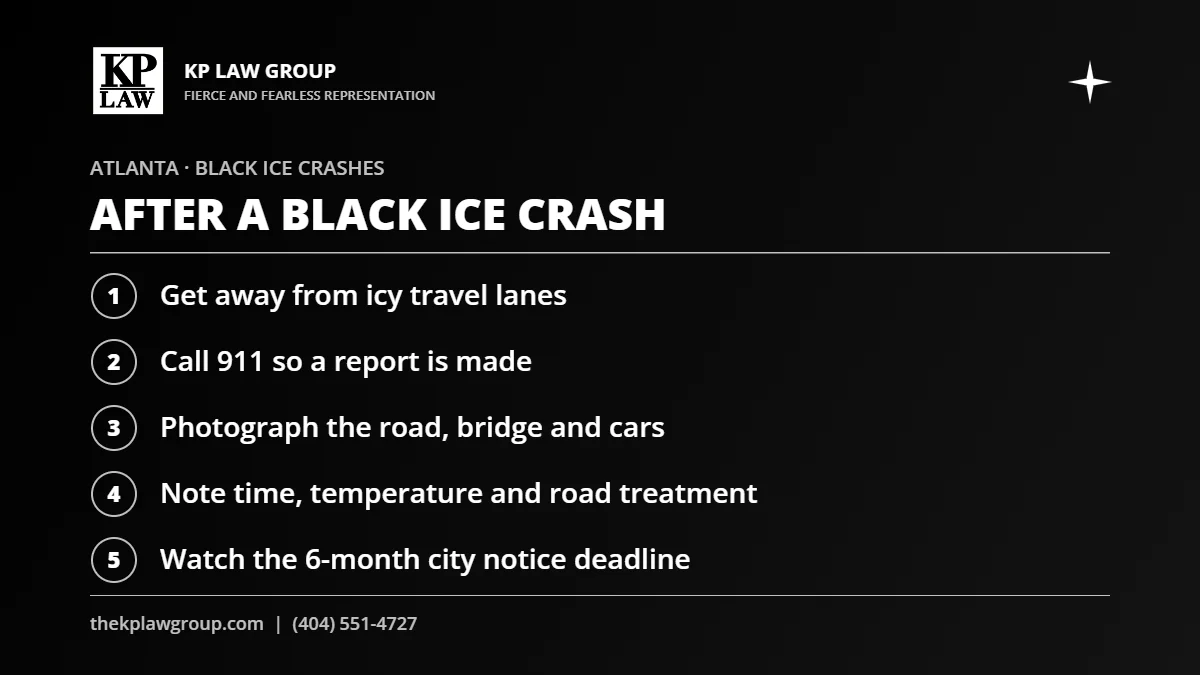
- Get to safety, away from travel lanes, since other cars may slide on the same ice.
- Call 911 for police and medical help so a crash report is made.
- Photograph the road surface, the bridge or ramp, the cars and any skid marks.
- Note the time, the temperature and whether the road looked treated with brine or salt.
- Get witness names and phone numbers.
- See a doctor promptly, even if you feel okay.
- Don’t give a recorded statement to the other driver’s insurer before you understand your rights.
- Talk with a lawyer quickly, especially if a government body may be involved.
Remember the outer limit too. Under O.C.G.A. 9-3-33, Georgia’s injury filing deadline, “actions for injuries to the person shall be brought within two years after the right of action accrues.”
Ride a motorcycle? See how Georgia’s helmet rule affects a claim.
Frequently Asked Questions
Is black ice considered an act of God in Georgia?
Not usually. Black ice is a known winter hazard, and Georgia law requires drivers to adjust their speed for weather and road conditions. A driver who goes too fast or follows too closely on ice may still be found at fault, even if ice was a factor.
Who is at fault if I slide on ice and hit another car?
It depends on how you were driving. If you were going too fast for the conditions or following too closely, you may be found at fault. If another driver’s actions or a known road hazard played a part, fault may be shared. Georgia lets you recover if you’re less than 50 percent at fault, with your award reduced by your share.
Can I sue the city for an icy road in Atlanta?
In some cases, yes, but it’s harder than a claim against a driver. You usually must show the city knew or should have known about a dangerous condition and failed to act. You also must send written ante litem notice within 6 months of the crash under O.C.G.A. 36-33-5, or the claim may be barred.
Does car insurance cover accidents on black ice?
Often, yes. If another driver caused the crash, their liability insurance may pay for your injuries and car damage. If you caused it, your collision coverage may pay for your own car, depending on your policy. Keep photos, the crash report and medical records in case fault is disputed.
How long do I have to file a black ice accident claim in Georgia?
For most injury claims against a driver, Georgia gives you 2 years from the crash under O.C.G.A. 9-3-33. Claims involving a government body have much shorter notice deadlines: 6 months for a city, 12 months for a county and 12 months for the state. Missing these deadlines can end a claim.
Talk With an Atlanta Car Accident Lawyer About Your Icy Road Crash
If you were hurt when roads froze in Atlanta or anywhere in Georgia, you don’t have to sort out fault alone. KP Law Group can review the crash report, the road conditions and the other driver’s choices, and check whether a government notice deadline applies.
Call (404) 551-4727 or reach out through our contact page for a free consultation. We can meet you where it’s convenient, and we speak Spanish. Hablamos Español.
This article is general information, not legal advice. Reading it does not create an attorney-client relationship. Every case is different. Talk with a lawyer about your situation.