


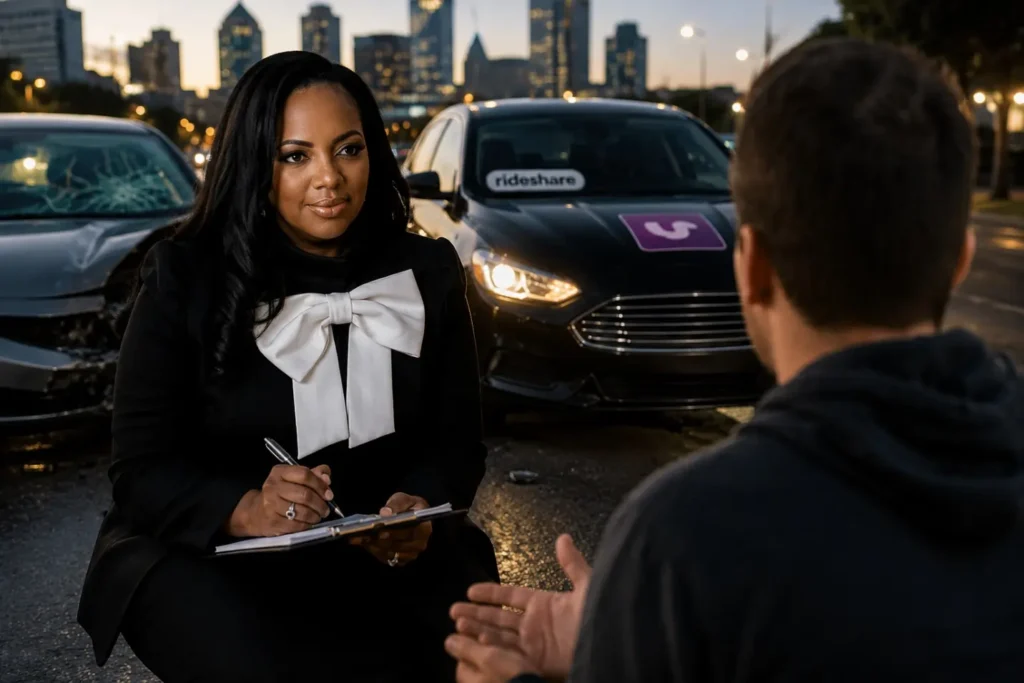
Yes, you can sue an Uber or Lyft driver personally in Atlanta, but whether that makes strategic sense depends on the circumstances. When the driver was offline, personal liability is your primary path. When the driver was actively working, Uber and Lyft carry substantial insurance coverage that is typically the better source of recovery. An Atlanta rideshare accident lawyer can help you identify the right strategy for your specific situation.
If you were injured in a crash involving an Uber or Lyft vehicle in Atlanta, your first instinct might be to go after the rideshare company itself. But after you learn that Uber and Lyft classify their drivers as independent contractors rather than employees, a natural question follows:
Can I sue the driver personally instead?
The short answer is yes, in certain situations you can. But whether pursuing the driver directly is the right strategy for your case depends on several factors that are worth understanding before you make any decisions. Here’s what Georgia law actually says, and what it means for your claim.
Before assuming your case will be heard by a jury, it is worth understanding how Uber and Lyft arbitration clauses can move certain claims out of court entirely.
Why the Driver’s Employment Status Matters So Much
When you’re injured by an employee acting within the scope of their employment, you can typically sue both the employee and the employer. The employer is vicariously liable for the employee’s actions.
Uber and Lyft have spent years and enormous legal resources arguing that their drivers are independent contractors, not employees. This matters because if that classification holds, the companies can argue they are not vicariously liable for driver negligence in the same way an employer would be.
Georgia courts have largely accepted the independent contractor framework, which means that simply naming Uber or Lyft in a lawsuit as the driver’s employer is not straightforward. What you can do, however, is pursue the driver directly on a personal negligence theory while also pursuing the company’s insurance coverage, which Georgia law now specifically addresses.
Georgia’s Rideshare Insurance Law and What It Actually Covers
Georgia enacted rideshare-specific legislation that clarifies the insurance obligations of transportation network companies like Uber and Lyft. This law divides coverage into three distinct periods:
Period 1 (App on, no ride matched): The rideshare company must provide at least $50,000 per person/$100,000 per accident in liability coverage and $25,000 in property damage coverage.
Period 2 (Ride accepted, driver en route): The rideshare company must provide at least $1 million in liability coverage, plus uninsured and underinsured motorist coverage.
Period 3 (Passenger in vehicle): The same $1 million minimum coverage applies.
App off entirely: The driver is not working for the rideshare company at all. The company’s insurance does not apply. The driver’s personal auto insurance is the relevant policy.
Understanding which period your accident falls into is one of the most important initial determinations in a rideshare case. The difference between Period 1 and Period 2 or 3 is potentially hundreds of thousands of dollars in available coverage.
When Does It Make Sense to Sue the Driver Personally?
Scenario 1: The Driver Was Not Using the App
If the Uber or Lyft driver had the app completely off at the time of your accident, they were operating as a private individual. The rideshare company’s insurance is not triggered at all. Your claim runs directly against the driver’s personal auto insurance policy and, if that coverage is insufficient, you can pursue the driver personally for the difference.
This is the scenario where suing the driver directly is most clearly applicable. Your claim is structured essentially the same way as any negligent driver case, except the driver happened to also work for a rideshare platform.
Scenario 2: The Driver’s Insurance Is Insufficient to Cover Your Damages
Even when the rideshare company’s insurance applies, there may be situations where your damages exceed available coverage. If your injuries are catastrophic and you’ve exhausted available insurance coverage, your attorney may evaluate whether pursuing the driver personally for additional recovery makes practical sense.
A key practical consideration: suing a driver personally only produces a recovery if the driver actually has assets. If the driver has little income and no meaningful property, a judgment against them personally may be difficult or impossible to collect. Your attorney will assess this before recommending a personal liability strategy.
One factor that affects how much you can recover from a personal suit is whether the driver was in an active trip or waiting for a request, a situation known as the rideshare insurance gap in Atlanta that can dramatically limit the coverage available to accident victims.
Scenario 3: The Driver Acted With Intentional or Reckless Misconduct
If the driver’s conduct went beyond ordinary negligence and amounted to intentional misconduct or reckless disregard for safety, personal liability becomes more significant. This might apply in situations involving road rage, DUI, or deliberate dangerous driving.
Even if the rideshare company’s insurance covers the claim, pursuing the driver personally in these situations may support a claim for punitive damages, which are not always available against insurers under the same theory.
What Happens When You’re a Passenger in the Uber or Lyft Vehicle?
If you were a paying passenger in the Uber or Lyft at the time of the crash, you are generally entitled to pursue the maximum coverage available under Period 2 or Period 3, which is $1 million in liability.
If the accident was caused by the other driver and not your Uber or Lyft driver, the analysis shifts to the other driver’s insurance. However, if the other driver is uninsured or underinsured, Uber and Lyft’s policies may include UM/UIM coverage that supplements your recovery.
As a passenger, your rights are typically the strongest in any rideshare accident scenario because you bear no fault for the crash.
What Happens When You’re a Third Party Struck by an Uber or Lyft Vehicle?
If you were in another vehicle, on a bicycle, or on foot when an Uber or Lyft driver struck you, your claim runs against the driver and the applicable insurance coverage based on which period the driver was in.
In Atlanta, where rideshare vehicles are everywhere near the airport, Midtown, Downtown, and Buckhead, pedestrian and cyclist accidents involving rideshare drivers are common. If you were injured by an Uber or Lyft driver while crossing the street or riding your bike, you have the same right to pursue the available coverage as any other accident victim.
How Uber and Lyft Respond to Accident Claims
Neither company is easy to deal with without legal representation. When an accident is reported, both Uber and Lyft typically conduct their own investigations. Their internal teams and insurance adjusters will contact you, sometimes quickly, with the goal of gathering information that can minimize your claim.
You are not required to provide a recorded statement to Uber, Lyft, or their insurance companies before consulting with an attorney. In fact, you should not. Anything you say can and will be used to limit what they pay.
An experienced Atlanta rideshare accident attorney will take over all communications with the insurance companies, handle the investigation, and ensure that your rights are protected from the moment you hire them.
How KP Law Group Handles Rideshare Accident Cases in Atlanta
At KP Law Group, we understand the multi-layered complexity of rideshare accident claims. When you come to us after an Uber or Lyft accident in Atlanta or anywhere in Fulton, DeKalb, or Cobb Counties, we immediately work to:
Determine which insurance period applies to your accident and what coverage is available
Preserve app and GPS data from the rideshare company that documents the driver’s status and route
Evaluate whether personal liability against the driver makes strategic sense in your specific case
Identify all available insurance policies, including your own UM/UIM coverage
Negotiate aggressively with the rideshare company’s insurers for full compensation
File a lawsuit and take the case to trial if necessary
We handle rideshare accident cases on a contingency fee basis. You pay nothing unless we recover for you.
Pedestrians struck by rideshare vehicles face a distinct set of challenges compared to passengers learn what to do if you were hit by an Uber or Lyft driver as a pedestrian in Atlanta.
Frequently Asked Questions About Suing Uber and Lyft Drivers in Atlanta
Q: What if the Uber driver says the accident wasn’t their fault?
A: The driver’s self-assessment of fault is irrelevant to your legal rights. Your attorney will investigate the facts independently and present the evidence that supports your claim.
Q: Can I sue both the driver and Uber or Lyft at the same time?
A: Yes. It is common to name multiple parties in a rideshare accident lawsuit. Your attorney will structure the claims appropriately based on the facts.
Q: I was a passenger and the driver was at fault. Do I need to prove anything?
A: As a passenger, you are not required to prove that you did anything wrong. You simply need to establish the driver’s negligence and your resulting damages.
Q: Uber contacted me right after the accident and wants a statement. Should I give one?
A: No. Contact an attorney before providing any statement to Uber, Lyft, or their insurance companies. Once you’ve given a recorded statement, it cannot be taken back.
Q: How long do I have to file a rideshare accident lawsuit in Georgia?
A: Generally two years for personal injury claims and four years for property damage. However, certain circumstances can affect this timeline. Contact an attorney as soon as possible to protect your rights.
Injured in an Uber or Lyft Accident in Atlanta?
You need a lawyer who understands Georgia rideshare law. Call KP Law Group today.
404-551-4727