



Fulton Industrial Boulevard is one of the busiest truck routes in metro Atlanta. Tractor-trailers, box trucks and bobtails pull in and out of warehouses all day, and a crash here can change your life in seconds. So who pays when it happens? In a Fulton Industrial Blvd truck accident, responsibility often goes beyond the driver.
The trucking company, the shipper that loaded the trailer, a freight broker, a repair shop or even a warehouse may share the blame under Georgia law. This guide explains how fault works, which rules matter, and what South Fulton families can do to protect a claim.
Quick answer
- The truck driver and the motor carrier are the most common responsible parties, but shippers, brokers, maintenance shops and warehouses may also share fault.
- Georgia generally gives you two years from the injury to file a lawsuit, and your recovery shrinks by your share of fault (and ends at 50 percent).
- Driver logs, maintenance files and camera footage can disappear fast, so getting help early often matters.
Why Fulton Industrial Blvd Truck Accidents Happen So Often
Fulton Industrial isn’t a typical commuter road. It’s a freight corridor. In 2021, the Georgia legislature moved 7.7 miles of Fulton Industrial, from Campbellton Road to I-20, into the City of South Fulton, according to the Atlanta Journal-Constitution. North of I-20, the corridor includes the last unincorporated part of Fulton County and a small piece of Atlanta.
Depending on where you were hit, the South Fulton Police Department, the Atlanta Police Department or a county agency may write the report. Knowing which one responded tells you where to request records.
The risks here are easy to picture:
- Trucks turning wide into loading docks and side streets.
- Rigs slowing or stopping in travel lanes while drivers look for an address.
- Heavy traffic near the I-20 interchange and big intersections like Donald Lee Hollowell Parkway.
These crashes aren’t rare. Early on September 30, 2026, a crash between a truck and a car at Fulton Industrial Boulevard and Westgate Parkway killed one person and critically injured another, Atlanta News First reported. All lanes were blocked. If you live or work nearby, our South Fulton personal injury page explains how we help people across the city.
Who Is Responsible for a Truck Accident in Georgia?
In Georgia, anyone whose carelessness helped cause the crash may be responsible. That usually starts with the truck driver and the trucking company. It can also include the shipper or loader, a freight broker, a maintenance shop, a warehouse or another driver. A jury can split fault among all of them by percentage.
The truck driver
Drivers cause crashes the same way anyone does: speeding, following too close, running a light, looking at a phone or making an unsafe turn. Truck drivers also face extra federal rules, like limits on how long they can drive. When a driver breaks one of those rules and someone gets hurt, that violation can be strong proof of carelessness.
The motor carrier
The trucking company is often the main target in a claim, and for good reason. A carrier is usually responsible for an employee driver’s mistakes on the job. It can also be at fault for its own choices, like hiring a driver with a bad record, skipping required checks, pushing schedules that make breaking the rules almost certain, or failing to fix known problems. Carriers also tend to carry much larger insurance policies than a single driver.
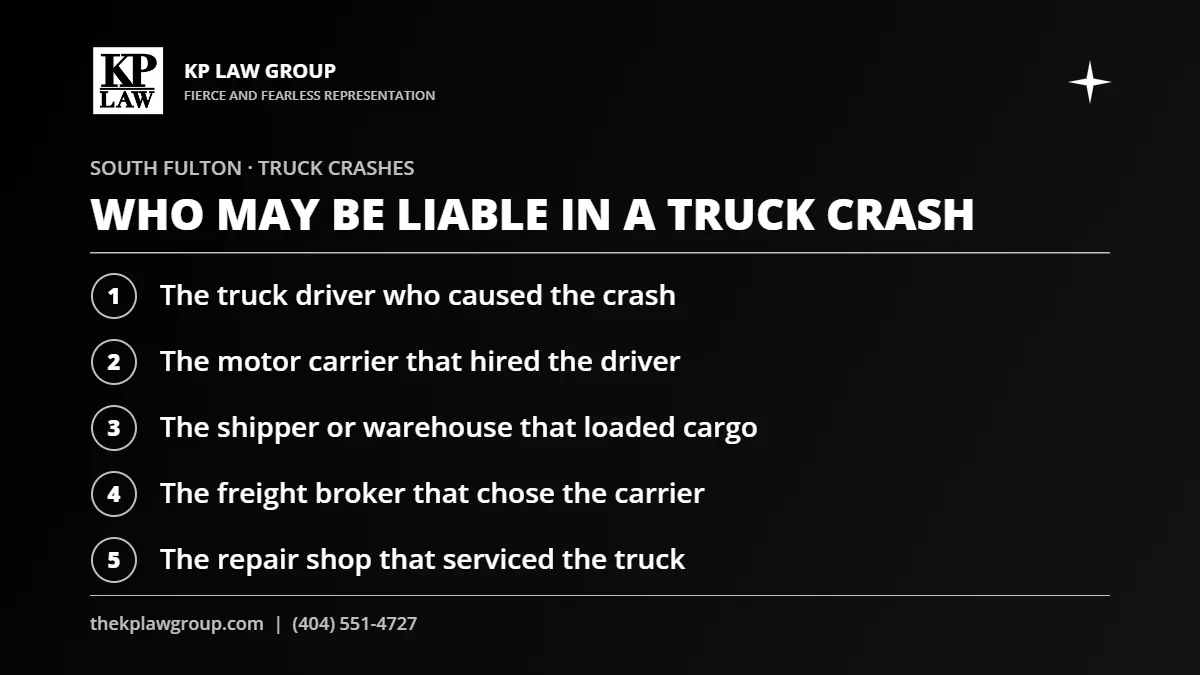
Beyond the Driver: Other Parties in a Fulton Industrial Blvd Truck Accident
Many companies touch each truck before it reaches the boulevard. Any of them may share fault.
Shippers and loaders
Federal cargo securement rules from the FMCSA require cargo to be firmly immobilized or secured so it won’t shift inside or fall from the truck. Those rules mainly put the duty on the motor carrier. But when a warehouse crew packs a sealed trailer badly, the load can shift on a turn and tip the rig. In some cases, the company that loaded it may share responsibility under Georgia negligence law.
Freight brokers
A broker arranges the haul but doesn’t drive it. Brokers may face claims when they hire a carrier with an obvious safety problem. These claims depend heavily on the facts and on how courts read federal law, so they need careful review.
Maintenance and repair shops
Brake failures, worn tires and broken lights often trace back to whoever worked on the truck. If an outside shop did sloppy work, that shop may be responsible alongside the carrier.
Warehouses and property owners
A facility that forces trucks to back across live lanes or stack up on the road shoulder may have played a role too. Our South Fulton truck accident lawyer page covers how we look at every company involved, not just the one named on the police report.
Federal Trucking Rules That Often Prove Fault
Big trucks follow a separate rulebook. When a company or driver breaks it, the violation can help show who was careless.
Hours of service
Tired drivers are dangerous drivers. Under the FMCSA hours of service rules, a property-carrying driver may drive a maximum of 11 hours after 10 consecutive hours off duty. They can’t drive past the 14th hour after coming on duty. They need a 30-minute break after 8 cumulative hours of driving. Electronic logs and delivery times can show whether a driver went over.
Driver qualification
Carriers must check out drivers before handing them the keys. FMCSA guidance on the driver qualification file lists what that file should hold: an employment application, a check of past employers’ safety history, driving records from every state where the driver held a license in the last three years, an annual record review, a road test or equivalent, and a medical certificate. A missing or thin file may point to negligent hiring.
Cargo and equipment
Loose loads and poorly kept trucks cause rollovers and brake failures. Inspection reports and repair invoices often tell the real story. You can read more about how these rules shape claims on our Atlanta truck accident lawyer page.
Georgia Law: Deadlines, Shared Fault and the Trucking Insurer
Georgia sets its own rules on deadlines, fault and insurers. Here’s a simple overview.
| Rule | What it means for you | Georgia law |
|---|---|---|
| Two-year deadline | Most injury lawsuits must be filed within two years after the right of action accrues, usually the crash date. | O.C.G.A. 9-3-33 |
| Shared fault | Your damages are reduced by your percentage of fault. At 50 percent or more, you recover nothing. | O.C.G.A. 51-12-33 |
| Suing the insurer directly | For claims arising on or after July 1, 2024, you can join a motor carrier’s insurer only in limited situations. | O.C.G.A. 40-1-112 |
The shared fault rule is why trucking insurers often try to blame the car driver. If they can push your share to half, your claim ends.
The insurer rule changed recently. Georgia used to let injured people name a trucking company’s insurer in the same lawsuit fairly freely. Under the 2024 amendment, that is now allowed mainly when a carrier is insolvent or bankrupt, or when the driver or carrier can’t be served despite reasonable effort. This doesn’t take away coverage. It changes how the case is set up, so it’s worth getting right from the start.
What to Do After a Fulton Industrial Blvd Truck Accident
The hours and days after a crash can shape the whole case. If you’re able, these steps help protect your health and your claim:
- Call 911 and get checked out, even if you feel okay. Some injuries show up later.
- Note which police agency responded and get the report number.
- Photograph the truck, its DOT number, the company name on the door, the trailer and any loose cargo.
- Write down the nearest cross street or business, like a warehouse address or the I-20 ramp.
- Get witness names and numbers, including warehouse workers.
- Don’t give a recorded statement to the trucking company’s insurer before getting advice.
- Keep every medical bill, pay stub and receipt tied to the crash.
- Talk with a truck accident lawyer quickly so evidence can be preserved.
Our guide on what to do after a truck crash in Fulton County walks through these steps in more detail.
Many drivers who use Fulton Industrial also run the Perimeter, so crashes often happen on the way to or from the highway. If your wreck happened on the interstate instead, see our I-285 truck crash guide for Atlanta drivers.
How Evidence Gets Lost, and How a Claim Gets Built
Truck cases turn on records, and much of that proof sits with the trucking company. Electronic logging data, dash camera video, GPS pings and inspection reports can be overwritten or thrown out under normal company routines.
A lawyer can send a preservation letter that tells the carrier, the shipper and nearby businesses to keep what they have. Along this corridor, warehouse gates and loading docks often have cameras pointed at the road. That footage may show the truck’s speed, its turn or a load that was already leaning. It’s usually gone within days or weeks unless someone asks for it.
From there, a claim often comes together in layers:
- Driver logs and dispatch messages show whether the schedule was realistic.
- Bills of lading show who loaded the freight and who arranged the haul.
- Medical records show how the crash changed your life.
Each layer can add a responsible party, and more responsible parties can mean more insurance available to cover serious injuries.
Hit by a car instead? Read steps after a Camp Creek Parkway crash.
Frequently Asked Questions
Can I sue the trucking company and not just the driver?
Yes, in many cases. Georgia law usually holds an employer responsible for an employee driver’s mistakes on the job. A trucking company may also be at fault for its own choices, like hiring an unsafe driver, ignoring hours of service rules or skipping repairs. Carriers often carry larger insurance policies than individual drivers.
How long do I have to file a truck accident claim in Georgia?
In most cases, Georgia gives you two years from the date of the injury to file a personal injury lawsuit under O.C.G.A. 9-3-33. Evidence like driver logs and camera video can fade long before that deadline, so acting early is usually wise.
What if I was partly at fault for the truck crash?
You may still recover money in Georgia. Under the state’s shared fault rule, your damages are reduced by your percentage of fault. If you’re found 50 percent or more responsible, you can’t recover. That’s why trucking insurers often try to shift blame onto the car driver.
Can the company that loaded the truck be held responsible?
Sometimes. Federal rules mainly make the motor carrier and driver responsible for securing cargo. But when a shipper or warehouse loads a sealed trailer badly and the cargo shifts, that company may share fault under Georgia negligence law. Bills of lading and loading records help show who handled the freight.
Who investigates crashes on Fulton Industrial Boulevard?
It depends on where the crash happened. Much of the corridor, from Campbellton Road to I-20, lies in the City of South Fulton, so the South Fulton Police Department may respond there. Crashes farther north may fall to Fulton County or the Atlanta Police Department. Check your report for the agency name.
Talk With a Truck Accident Lawyer Serving South Fulton
If a truck crash on Fulton Industrial Boulevard hurt you or someone you love, you don’t have to sort out the trucking company, the insurers and the deadlines alone. KP Law Group is based in Midtown Atlanta and serves clients throughout South Fulton. We come to you when it helps. Hablamos Español.
Call (404) 551-4727 or request your free consultation online. We’ll listen, explain your options under Georgia law and help you decide on next steps.
This article is general information, not legal advice. Reading it does not create an attorney-client relationship. Every case is different. Talk with a lawyer about your situation.