


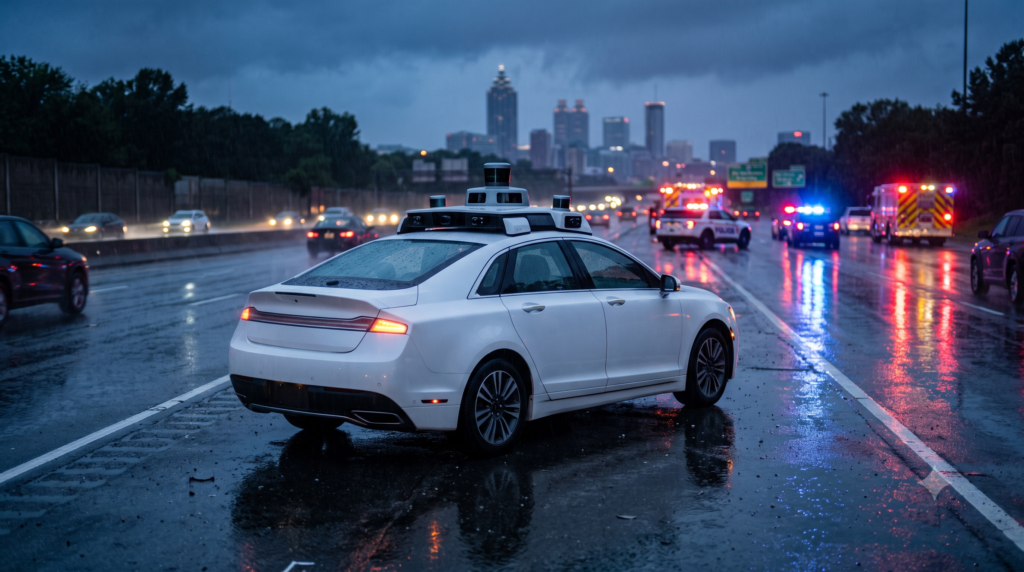
Self-driving and driver-assist vehicles are now common on Atlanta roads, and when they crash, liability can fall on the human driver, the vehicle manufacturer, a software company, or a fleet operator—sometimes all at once. Georgia victims generally have two years to file a personal injury claim, but these cases require pulling vehicle data quickly before it is overwritten. An experienced Atlanta personal injury lawyer can help identify every liable party and preserve the evidence that proves what actually happened.
Atlanta’s roads look different than they did five years ago. Robotaxis move through Midtown. Tesla drivers rely on Autopilot along I-85. Delivery vans use lane-keeping and automatic braking systems that sometimes act on their own. Most of the time, this technology works. When it does not, the result is a car accident that raises a question traditional crash cases never had to answer: was a person driving, or was the car driving itself?
This question matters because it changes who can be held responsible for your injuries. If you were hurt in a crash involving an autonomous or driver-assist vehicle, speaking with an experienced Atlanta car accident lawyer as soon as possible can help protect your legal rights.
What Counts as a Self-Driving Car Accident in Georgia?
Not every crash involving smart technology is a true “self-driving” accident. Georgia roads currently see three categories of vehicles that raise liability questions:
- Driver-assist vehicles use features like adaptive cruise control, lane-keeping assist, and automatic emergency braking, but a human is still legally in control. Most Tesla, Ford, and GM vehicles on Atlanta roads fall into this category.
- Conditional automation vehicles can handle full driving tasks in specific conditions, but a human driver must be ready to take over. Confusion about who was “in control” at the moment of the crash is common in these cases.
- Fully autonomous vehicles, including robotaxi pilots operating in parts of metro Atlanta, have no human driver at all. When one of these vehicles causes a crash, the fault analysis looks completely different from a typical car accident case.
Knowing which category applies to the vehicle that hit you is the first step in building your claim.
Who Can Be Held Liable After a Self-Driving Car Crash?
This is where autonomous vehicle cases become more complex. Depending on the facts, liability may fall on:
- The human driver, if they failed to monitor the system, did not take control when required, or misused the technology.
- The vehicle manufacturer, if defective hardware, sensors, or software caused the system to fail.
- The software or technology company, if the autonomous driving platform was created or licensed by another company.
- The fleet or rideshare operator, if the vehicle was part of a commercial autonomous fleet, such as a robotaxi service.
- A third-party maintenance provider, if sensors, cameras, or software were improperly serviced before the collision.
Many autonomous vehicle accident claims involve multiple liable parties. Georgia follows a modified comparative negligence rule, meaning compensation can be reduced according to each party’s percentage of fault. If an injured person is found more than 50% responsible, they cannot recover damages.
Why Evidence Disappears Quickly in Self-Driving Vehicle Cases
Traditional car accident claims rely on police reports, witness statements, photographs, and vehicle damage. Autonomous vehicle accidents add another critical layer—digital vehicle data.
Every driver-assist and autonomous vehicle records information about what its systems detected, the decisions it made, and whether the human driver attempted to intervene. This information is often stored on servers controlled by the manufacturer or software provider and may be overwritten or deleted if not preserved promptly.
An attorney can immediately send a spoliation letter requiring manufacturers, fleet operators, or software companies to preserve this evidence before it disappears. Waiting too long could result in losing some of the strongest evidence available.
Steps to Take After a Self-Driving or Driver-Assist Accident in Atlanta
- Call 911 and obtain a police report. Make sure the responding officer notes whether an autonomous or driver-assist system was active.
- Take photographs of both vehicles, road conditions, visible sensors, cameras, skid marks, and surrounding traffic.
- Obtain the rideshare or fleet company information, along with the vehicle identification number (VIN), if possible.
- Seek immediate medical treatment, even if injuries seem minor.
- Avoid discussing the accident on social media or giving recorded statements to insurance adjusters before consulting an attorney.
- Contact an experienced attorney immediately so critical electronic vehicle data can be preserved.
How Compensation Is Calculated in Georgia Autonomous Vehicle Cases
Georgia law allows injured victims to pursue compensation for:
- Medical expenses
- Lost wages and reduced earning capacity
- Pain and suffering
- Property damage
- Other accident-related losses
Claims against human drivers typically proceed under negligence law, while claims against manufacturers often involve product liability. In many self-driving accident cases, both legal theories are pursued together against multiple defendants.
Because Georgia’s recent tort reform legislation has changed aspects of personal injury litigation, working with a law firm experienced in both autonomous vehicle technology and modern injury law is essential.
To learn how KP Law Group has successfully represented injured clients, visit our Case Results page.
Frequently Asked Questions
Q: Who is at fault if a self-driving car hits me in Atlanta?
A: Fault depends on the level of automation involved. Liability may rest with the human driver, vehicle manufacturer, software developer, fleet operator, or multiple parties.
Q: Is a Tesla using Autopilot legally considered self-driving?
A: No. Tesla Autopilot and similar driver-assist systems still require an attentive human driver. However, manufacturers may still share liability if a defect contributed to the collision.
Q: How long do I have to file a claim after an autonomous vehicle accident in Georgia?
A: In most cases, Georgia gives injured victims two years from the accident date to file a personal injury claim. Certain product liability claims may involve additional legal considerations, making early legal advice important.
Q: What if the robotaxi company claims its system was not responsible?
A: Vehicle data collected immediately after the crash often provides the strongest evidence of what actually occurred. An attorney can take legal steps to preserve and obtain this information.
Q: Can I recover compensation if I was partly responsible for the accident?
A: Yes. Under Georgia’s modified comparative negligence law, you may still recover damages as long as you are not more than 50% at fault. Your compensation will be reduced by your percentage of fault.
Contact KP Law Group Today
If a self-driving or driver-assist vehicle caused your injuries in Atlanta, the technology involved does not eliminate your right to pursue compensation—it simply makes the legal process more complex. Our attorneys understand how to investigate autonomous vehicle crashes, preserve critical electronic evidence, and identify every responsible party.
Schedule your Free Fierce & Fearless Case Review today by calling 404-551-4727 or contact KP Law Group online.