


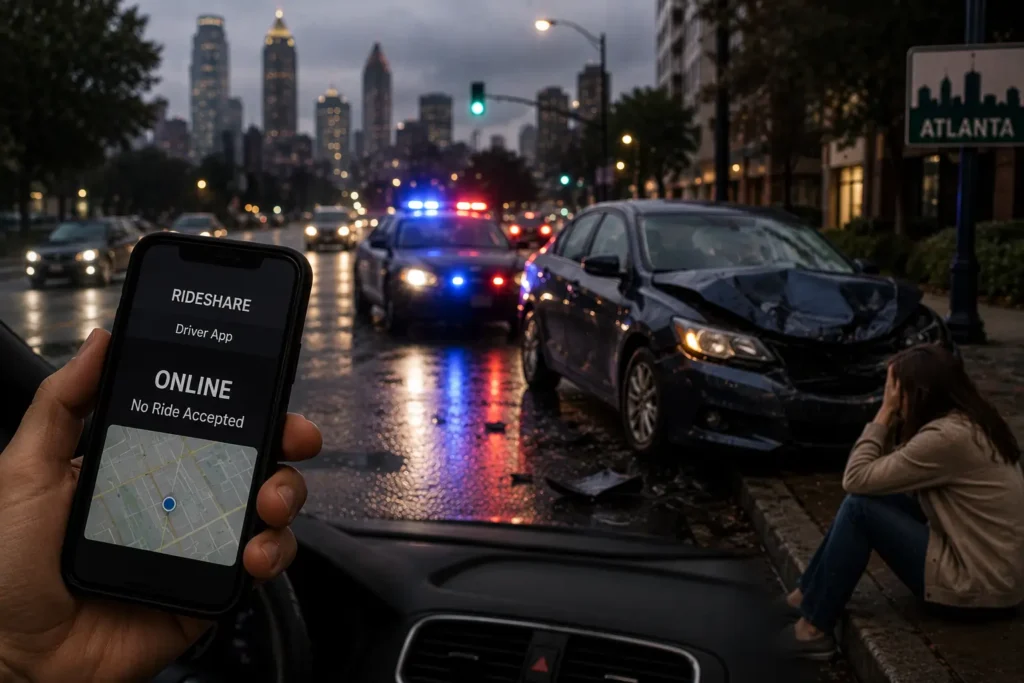
When an Uber or Lyft driver is logged into the app but has not yet accepted a ride, Georgia personal auto insurance policies typically exclude coverage while the rideshare company’s coverage is also limited — typically $50,000 per person. This insurance gap, known as Period 1, is one of the most misunderstood coverage situations for Atlanta accident victims. Knowing which coverage applies and how to pursue compensation when it falls short is essential.
Most Atlanta residents know that Uber and Lyft carry substantial insurance coverage when their drivers are on active trips. What many do not know is what happens during the minutes — sometimes hours — when a driver is logged into the app, waiting for a ride request that has not yet come in.
That window is called Period 1. And it is where some of the most confusing, and potentially costly, insurance situations in Georgia rideshare law take place.
If you were injured in a crash involving an Uber or Lyft driver who was online but had not yet accepted a ride, you are navigating one of the most complex coverage scenarios in modern personal injury law.
Georgia’s new rideshare insurance law narrows this gap by setting clearer coverage minimums for each phase of a trip.
Understanding the Three Periods of Rideshare Driver Status
Rideshare insurance coverage operates on a phase system based on what the driver is doing at the moment of the accident.
Period 0 — App is off: The driver is operating their personal vehicle with no connection to the rideshare platform. The driver’s personal auto insurance applies exclusively.
Period 1 — App is on, waiting for a ride request: The driver is logged in and available but has not yet matched with a passenger. This is the coverage gap period.
Period 2 — Ride accepted, en route to passenger: The driver has accepted a request and is driving to pick up the rider.
Period 3 — Passenger in the vehicle: The trip is fully active.
In Periods 2 and 3, both Uber and Lyft generally provide $1 million per occurrence in liability coverage. The problem is Period 1.
What Coverage Applies During Period 1 in Georgia?
During Period 1, both Uber and Lyft provide limited liability coverage far below what applies during active trips. As of 2026, both platforms generally provide:
- $50,000 in bodily injury per person
- $100,000 in bodily injury per accident
- $25,000 in property damage
That coverage sounds reasonable — until you consider two important realities.
First, serious accident injuries in Atlanta often generate medical bills exceeding $50,000 quickly. Emergency care, surgeries, extended rehabilitation, and lost income can easily push total damages well above the Period 1 limits.
Second, and critically, this coverage may only apply if the driver does not have their own valid personal auto policy covering rideshare activity. Georgia personal auto insurance policies frequently exclude rideshare activity — meaning when the app is on, the driver’s personal insurer may deny the claim entirely. The Period 1 gap coverage becomes the only insurance available, and it has a much lower ceiling than active-trip coverage.
Why Georgia Personal Auto Policies Do Not Cover Period 1
Standard personal auto policies in Georgia include a commercial use exclusion. When a vehicle is being used for commercial purposes — including logging into a rideshare app with the intent to accept paid rides — the personal policy frequently excludes coverage.
Georgia’s insurance environment means that a driver logged into Uber with no ride accepted is, in the view of their personal insurer, operating a commercial vehicle. Their consumer auto policy does not cover that.
Some drivers purchase rideshare endorsements on their personal policies, which bridge the Period 1 gap. But many do not. When a driver has no rideshare endorsement and causes an accident during Period 1, the available insurance is limited to whatever Uber or Lyft’s platform provides — significantly less than active-trip coverage.
Practical Impact for Atlanta Accident Victims
Consider this scenario: A pedestrian in Midtown Atlanta is struck by an Uber driver who was logged in and cruising, waiting for a request. The pedestrian sustains serious injuries. Medical bills reach $120,000. Lost income from the resulting disability adds another $60,000.
Under Period 1 coverage, the maximum available per-person bodily injury coverage from the platform may be $50,000. The gap between actual damages and available insurance exceeds $130,000.
Unless the driver has a rideshare endorsement on their personal policy or significant personal assets, the victim faces a coverage shortfall that is extremely difficult to close.
This is exactly why determining what period a rideshare driver was in at the moment of a crash is one of the first questions an Atlanta rideshare accident attorney must answer.
How to Determine What Period Applied in Your Accident
The first step in any rideshare accident investigation is establishing the driver’s app status at the exact moment of the crash. Uber and Lyft maintain timestamped records of driver app status, including when drivers go online, accept rides, and complete trips.
These records are critical evidence, but they are not automatically provided. Obtaining them requires formal legal process — either through direct attorney contact with the platform’s legal team or through formal discovery. Engaging an Atlanta rideshare accident lawyer quickly protects your access to this evidence.
Other Insurance Recovery Options When Period 1 Coverage Is Insufficient
When Period 1 coverage does not fully compensate an accident victim’s losses, Atlanta attorneys explore additional recovery avenues:
Uninsured/underinsured motorist (UM/UIM) coverage: If the victim has their own Georgia auto policy with UM/UIM coverage, and the at-fault driver’s available insurance is insufficient to cover all damages, the victim’s own UM/UIM coverage may be triggered. This is one of the most important reasons Georgia drivers should carry UM/UIM coverage.
The driver’s personal rideshare endorsement: Some drivers do purchase this coverage. An attorney can compel production of the driver’s full insurance declarations through formal legal channels.
Direct claims against the driver: If the driver has personal assets and damages exceed available coverage, a personal judgment may be pursued.
Third-party liability: In certain crashes where road conditions, vehicle defects, or third-party negligence contributed, additional defendants may be available.
Summer 2026: Rideshare Activity Is High in Atlanta
June through August is one of the busiest periods for rideshare activity in Atlanta. Concerts at State Farm Arena, events in Piedmont Park, Braves games at Truist Park, summer tourism, and late-night activity across Buckhead, Midtown, and Old Fourth Ward all drive rideshare demand.
Higher demand means more drivers logged in and circulating in Period 1 — more vehicles waiting for requests in busy corridors. For Atlanta pedestrians, cyclists, and other drivers sharing the road, that means a higher probability of encountering a rideshare vehicle in this coverage gap window right now.
KP Law Group Handles the Hard Rideshare Cases
When a rideshare accident claim is complicated by coverage gaps, period disputes, or insufficient insurance, you need an attorney who has navigated this terrain before and knows how to push for full compensation.
KP Law Group represents rideshare accident victims across Atlanta and in Fulton, DeKalb, and Cobb Counties. We investigate the app data, identify the correct insurance coverage, and build the strongest possible claim for every client we represent.
Frequently Asked Questions
Q: What is the rideshare insurance gap in Georgia?
The rideshare insurance gap refers to Period 1 — when a driver is logged into the Uber or Lyft app but has not yet accepted a ride. During this period, the driver’s personal auto insurance typically excludes coverage due to a commercial use exclusion, and the rideshare platform’s coverage is limited to $50,000 per person and $100,000 per accident — far below the $1 million provided during active trips.
Q: What happens if the Uber or Lyft driver’s insurance does not fully cover my injuries?
If you have uninsured or underinsured motorist (UM/UIM) coverage on your own Georgia auto policy, you may be able to access that coverage when the at-fault driver’s available insurance is insufficient. You may also have a direct claim against the driver’s personal assets. An Atlanta rideshare accident lawyer can evaluate all your recovery options.
Q: How do I find out what period the rideshare driver was in when the accident happened?
Uber and Lyft maintain internal records showing driver app status at the time of any crash. These records can be obtained through an attorney’s formal request or through legal discovery. Contact an attorney quickly — these records must be preserved promptly.
Q: Does Georgia require rideshare drivers to carry special insurance?
Georgia does not currently require rideshare drivers to carry a personal rideshare insurance endorsement. Without one, the driver’s personal policy will typically not cover any Period 1 claim. Some drivers voluntarily carry rideshare endorsements; many do not.
Q: Can I still recover if I was partly at fault in an Atlanta rideshare accident?
Georgia’s modified comparative negligence rule allows you to recover compensation as long as you are less than 50 percent at fault. Your recovery will be reduced by your percentage of fault, but you are not automatically barred from recovery simply because you shared some responsibility for the accident.
CALL TO ACTION
If you were hurt in a rideshare accident in Atlanta — regardless of whether the driver had an active trip — you may have more options than you realize. The insurance picture in these cases is complicated, and the right attorney makes all the difference.
Contact KP Law Group today for a free consultation.
404-551-4727 | Free Fierce and Fearless Case Review | thekplawgroup.com