


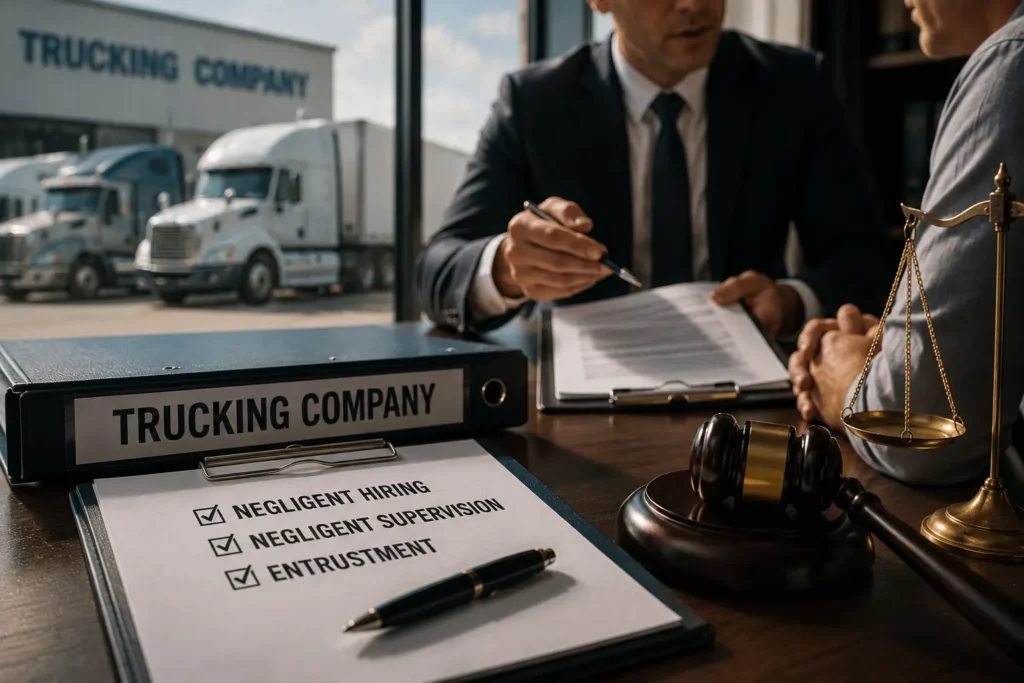
In Georgia, you can sue the trucking company directly — not just the driver — under several legal theories including vicarious liability, negligent hiring, negligent supervision, and negligent entrustment. These claims can significantly increase the compensation available to victims and access the company’s insurance coverage, which often carries much higher policy limits than an individual driver’s coverage alone.
After a serious trucking accident in Atlanta, the first question most people ask is: who is responsible? The instinctive answer is the truck driver. But in many Georgia trucking accident cases, the driver is not the most important defendant in the lawsuit.
The trucking company often is.
Under Georgia law, victims of commercial truck accidents may be able to sue the trucking company directly, separate from any claim against the driver, and for reasons entirely within the company’s own control. These direct corporate liability claims — built on negligent hiring, negligent supervision, negligent entrustment, and negligent maintenance — are among the most powerful tools available to Atlanta truck accident victims.
Understanding how these claims work could significantly change the outcome of your case.
Vicarious Liability: The Starting Point
Most truck accident lawsuits begin with vicarious liability. Under Georgia law, an employer is generally responsible for the negligent acts of its employees performed within the scope of their employment.
That means if a truck driver causes an accident while making a scheduled delivery, the trucking company that employs him is automatically liable for the resulting damages — even if the company did nothing wrong individually.
Vicarious liability is powerful, but it has limitations. It requires proving the driver was negligent and was acting within the scope of employment at the time. Trucking companies sometimes dispute both elements.
That is why Georgia personal injury attorneys who handle trucking cases do not stop at vicarious liability. They build direct negligence claims against the company as well.
Negligent Hiring: What Did the Company Know Before Putting This Driver on the Road?
Federal FMCSA regulations require trucking companies to conduct background checks and qualify drivers before putting them behind the wheel of a commercial vehicle. When a company hires a driver without properly vetting their driving history, checking for prior violations, or confirming their commercial driver’s license (CDL) is valid, that failure may constitute negligent hiring.
Under Georgia law (O.C.G.A. Section 51-2-3), negligent hiring claims arise when a company knew — or should have known — that a driver was unfit for the job.
Examples that commonly surface in Atlanta trucking accident investigations:
- A driver with multiple DUI or reckless driving violations who was hired without a proper background check
- A driver whose CDL had been suspended but who was placed on a route anyway
- A driver with a documented history of hours-of-service violations at a prior employer
- A driver who failed a required drug test at a previous company but was hired without drug screening
Trucking companies are required to maintain a qualification file for each driver. That file is a primary target in litigation because it reveals exactly what the company knew — and when it knew it.
Nearly every negligent hiring claim against a Georgia motor carrier is proven or lost inside one set of records, and that is why the driver qualification file is usually the first document an Atlanta truck accident lawyer demands.
Negligent Supervision: What Did the Company Do After Hiring the Driver?
Negligent hiring asks what happened before the crash. Negligent supervision asks what happened after the driver was on the payroll.
Georgia recognizes negligent supervision claims when a company fails to properly monitor, train, or correct a driver’s dangerous habits after discovering — or when it should have discovered — those patterns.
Common examples:
- A driver who accumulates multiple moving violations after being hired, but the company takes no corrective action
- A driver who logs hours-of-service violations, but the company continues to assign runs without investigating
- A driver who has prior at-fault accidents with the company but receives no additional training
- A company that does not conduct post-accident drug testing as required by FMCSA regulations
In Atlanta and across the Georgia freight corridor, many large trucking companies operate under tight margin pressure, which sometimes leads dispatch managers to overlook driver behavior problems because a driver is productive and available. That tolerance for risk is exactly what negligent supervision claims expose in litigation.
Negligent Entrustment: Did the Company Know This Driver Should Not Have Been Given the Keys?
Negligent entrustment focuses specifically on the decision to give a particular driver access to the vehicle. Under Georgia law, a company commits negligent entrustment when it allows an incompetent, reckless, or unqualified driver to operate one of its commercial vehicles — particularly when the company had reason to know the driver was unfit.
This theory becomes especially important when:
- A driver was known to be impaired by alcohol or drugs
- A driver was visibly fatigued before the trip began
- A driver lacked the proper endorsements or licensing for the type of vehicle assigned
- A driver had recent disciplinary issues that should have prevented dispatch
Negligent entrustment claims can be brought not just against the employer, but also against any business or individual who gave a driver access to a vehicle they should not have been operating.
Negligent Maintenance: Was the Truck Itself a Risk?
Trucking companies are required under federal regulations to maintain their vehicles in safe operating condition. Required maintenance includes brake inspections, tire checks, lighting systems, and critical components like underride guards, hitches, and load-securing equipment.
When a preventable mechanical failure contributes to an Atlanta truck accident, the company may face a negligent maintenance claim in addition to claims against the driver.
Maintenance records, inspection logs, and third-party inspection reports all become relevant in these cases. Georgia courts take destruction or non-production of these records seriously.
Why Corporate Claims Matter: Insurance Limits and Real Recovery
Commercial trucking policies carry far higher policy limits than personal auto insurance — federal regulations require a minimum of $750,000 in liability coverage for most commercial motor carriers, and many larger operations carry $1 million or more.
But direct corporate liability claims matter beyond insurance coverage. When a trucking company is found directly liable for negligent hiring, supervision, entrustment, or maintenance, Georgia law may also allow punitive damages — designed to punish willful or wanton misconduct and deter future bad behavior.
If evidence shows a trucking company knew a driver was unfit, knew equipment was defective, or consistently pressured drivers to violate federal hours-of-service rules, punitive damages become a real possibility in Georgia courts.
What Evidence Do You Need to Build a Corporate Liability Case?
An Atlanta trucking accident lawyer who handles direct corporate liability claims will typically pursue:
- The driver’s complete qualification file (background check, license verification, prior employer checks)
- The driver’s personnel file (complaints, disciplinary actions, prior accidents)
- Electronic logging device (ELD) data showing hours-of-service patterns
- Drug and alcohol testing records
- Vehicle maintenance logs and DOT inspection reports
- Dispatch records and communications between the company and the driver before the accident
- Training records and safety policies
Many of these records are only available through formal legal discovery, which is why engaging a lawyer who can send a formal evidence preservation demand is often necessary.
Brokers and shippers can also share responsibility, which is why understanding freight broker liability in an Atlanta truck accident matters when the carrier’s insurance is not enough to cover a catastrophic injury.
Acting Fast in Atlanta Trucking Cases Is Critical
Georgia’s statute of limitations for personal injury cases is generally two years from the date of the accident. But corporate trucking records do not stay preserved indefinitely. Federal regulations require retention of certain records, but that retention period ends — and when it does, evidence that could support your corporate liability claim disappears.
Sending a spoliation letter through your attorney immediately after the accident creates a legal obligation for the trucking company to hold those records. Waiting even a few weeks can cost you access to the evidence that makes the difference between a settlement and a verdict.
Georgia law also controls when you can bring a direct action lawsuit against trucking insurance in Georgia, and those rules changed for crashes on or after July 1, 2024.
KP Law Group Goes After Trucking Companies, Not Just Drivers
At KP Law Group, we understand that the driver in the cab is often not the only party responsible for your injuries. The company that put him on the road, failed to check his record, ignored his violations, and dispatched him past his legal driving limits may bear significant responsibility too.
We represent Atlanta trucking accident victims in Fulton County, DeKalb County, and Cobb County with fierce, fearless legal strategy. Our firm goes beyond the obvious defendant and builds cases that hold the entire system accountable.
Frequently Asked Questions
Can I sue a trucking company in Georgia even if the driver was an independent contractor?
Potentially, yes. Independent contractor classifications in trucking are frequently challenged in Georgia courts. When a trucking company controls the driver’s operations, owns the vehicle, or structured the arrangement to avoid liability, courts may disregard the independent contractor label and impose employer liability.
What is negligent entrustment under Georgia law?
Georgia recognizes negligent entrustment under O.C.G.A. Section 51-2-3 when a company allows an incompetent or reckless driver to use one of its vehicles knowing the driver poses a risk. It focuses on the company’s own decision-making, not just the driver’s conduct at the time of the accident.
Does suing the trucking company increase the amount I can recover?
Often, yes. Direct corporate liability claims can expose the trucking company’s full commercial insurance policy limits, which are typically much higher than what an individual driver’s coverage would provide. Egregious conduct may also support a punitive damages claim under Georgia law.
What records should a trucking company have about its drivers?
Federal regulations require trucking companies to maintain driver qualification files containing employment applications, CDL verification, motor vehicle records, road test documentation, prior employer safety performance history, and drug and alcohol testing records. These files are a primary target in negligent hiring litigation.
How long do I have to sue a trucking company in Georgia?
Georgia’s statute of limitations for personal injury cases is generally two years from the date of the accident. However, corporate records retention periods may be shorter, so contacting an attorney immediately to send a preservation demand is strongly recommended.
CALL TO ACTION
Do not limit your case to the driver. If a negligent trucking company put a dangerous driver on Atlanta’s roads, they need to be held fully accountable.
Contact KP Law Group for a free case review. We represent clients across Atlanta and in Fulton, DeKalb, and Cobb Counties.
404-551-4727 | Free Fierce and Fearless Case Review | thekplawgroup.com