


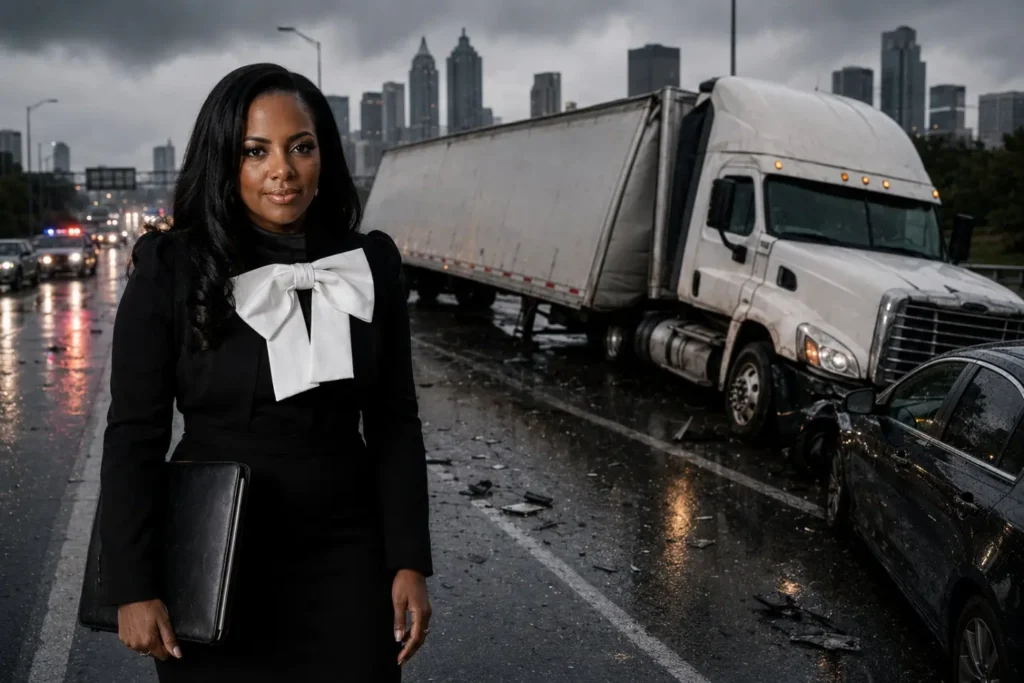
A jackknife accident happens when a semi-truck’s cab and trailer fold into each other like a closing pocket knife, often sweeping across multiple lanes and causing catastrophic collisions. These crashes involve multiple potentially liable parties — the driver, the trucking company, maintenance contractors, and cargo loaders. Victims have two years to file a claim in Georgia, but evidence preservation must begin immediately.
If you have ever driven the Downtown Connector or I-285 around Atlanta, you have probably seen the aftermath of a truck jackknife — an 80,000-pound vehicle folded across multiple lanes, traffic stopped for miles, emergency responders working in dangerous conditions. These crashes are terrifying to witness. For the drivers and passengers struck by a jackknifing trailer, the results are frequently catastrophic.
Jackknife truck accidents are not like standard rear-end collisions. They involve unique physics, complex liability questions, and evidence that can disappear within days of the crash. If you or someone you love was hit by a jackknifing truck in Atlanta, Fulton County, DeKalb County, or anywhere in Metro Georgia, this guide gives you the foundation you need to protect your rights.
What Causes a Truck to Jackknife?
A jackknife occurs when a semi-truck’s drive wheels lock up or lose traction, causing the trailer to swing out from behind the cab. The cab and trailer fold at the coupling point into a V or L shape, sweeping across adjacent lanes.
The most common causes of jackknife accidents on Atlanta’s highways include:
- Sudden or improper braking. When a truck driver brakes too hard, especially at highway speeds, the drive wheels can lock. Without anti-lock braking systems in proper working order, the trailer swings wide. Georgia’s wet weather and frequent stop-and-go on I-75 and I-85 create exactly these conditions.
- Excessive speed. Trucks going too fast for road conditions reduce their ability to maintain stability under braking or steering inputs.
- Brake system failure. Federal regulations require trucking companies to maintain brakes in proper adjustment. Out-of-adjustment brakes can lock prematurely during hard stops.
- Improper cargo loading. When freight is not secured or balanced correctly, weight shifts during maneuvers, throwing off the truck’s center of gravity.
- Fatigued or impaired driving. Fatigued drivers react more slowly and make worse braking decisions. Federal hours-of-service regulations exist to prevent driver fatigue, but violations are common.
- Equipment malfunction. Defective components — worn tires, faulty ABS, broken coupling hardware — can cause jackknife events independent of driver behavior.
While jackknife crashes typically happen at highway speeds, large trucks also cause serious injuries during low-speed maneuvers — especially in a wide turn truck accident in Atlanta where a turning 18-wheeler swings into adjacent lanes or onto the curb.
Why Jackknife Crashes Are So Dangerous
The physics of a jackknife make these crashes uniquely deadly. As the trailer swings, it can occupy two or three lanes simultaneously. Any vehicle in those lanes gets struck by the side of a 40-foot trailer at whatever speed traffic is moving. Occupants of passenger vehicles struck by a jackknifing trailer have little protection against that mass and force.
Common injuries in Atlanta jackknife truck accidents include:
- Traumatic brain injuries
- Spinal cord injuries and paralysis
- Internal organ damage
- Crush injuries and amputations
- Severe fractures and broken bones
- Burns from fuel spills or fires
- Wrongful death
The high-speed environment of Atlanta’s interstates means these injuries tend to be at the severe end of the spectrum.
Who Is Liable for a Jackknife Truck Accident in Georgia?
Multiple parties can share liability in jackknife cases, and identifying all of them matters because each carries separate insurance coverage.
The truck driver. If the jackknife was caused by speeding, improper braking, fatigue, or distracted driving, the driver bears personal liability.
The trucking company. Under respondeat superior, trucking companies are vicariously liable for the negligent acts of drivers they employ. The company may also be independently liable for negligent hiring, inadequate training, and failure to enforce hours-of-service rules. FMCSA regulatory violations are evidence of negligence.
The cargo loading company. If improper loading contributed to the jackknife, the company responsible for loading the trailer may share liability. This can be a separate entity from the trucking company.
Maintenance contractors. If brake failure or equipment defects resulted from poor maintenance, the company contracted to maintain the truck may be liable.
The vehicle manufacturer. If a defective part — ABS system, braking hardware, coupling mechanism — caused or contributed to the jackknife, the manufacturer may face product liability claims.
An Atlanta jackknife truck accident attorney investigates all of these angles simultaneously, because the trucking company and its insurers will conduct their own rapid investigation designed to minimize their exposure.
The Evidence That Makes or Breaks a Jackknife Claim
Evidence in trucking cases disappears fast. Trucking companies often have rapid-response teams that arrive at crash scenes before attorneys for victims. Here is what needs to be preserved:
- Electronic Logging Device (ELD) data. Federal regulations require commercial trucks to use ELDs that record hours of service. This data shows whether the driver complied with rest requirements before the crash.
- Event Data Recorder (EDR) data. Often called the truck’s black box, the EDR captures pre-crash speed, braking inputs, and steering. This data can be overwritten if not preserved through a litigation hold letter immediately.
- Driver qualification files. Your attorney can demand the driver’s complete employment file, including prior accidents, traffic violations, and drug test results.
- Vehicle inspection and maintenance records. Were the brakes properly adjusted? When were they last inspected? These records are required by federal law and are essential in brake-related jackknife cases.
- Cargo loading records and bills of lading. If load imbalance contributed to the crash, loading records are critical evidence.
- GDOT camera and dashcam footage. Atlanta’s interstate corridors have extensive camera coverage. Nearby businesses may also have captured the crash. This footage must be requested before overwriting occurs.
How Georgia Law Governs Jackknife Truck Accident Claims
Georgia’s two-year statute of limitations generally applies to personal injury claims from truck accidents (O.C.G.A. Section 9-3-33). However, the critical actions — preserving evidence, issuing litigation hold letters, gathering ELD and EDR data — need to happen immediately after the crash.
Georgia also applies its modified comparative fault rule, allowing you to recover as long as you are less than 50 percent responsible for the crash. Trucking company defense teams routinely try to argue that passenger vehicle drivers contributed to the crash. A strong legal team fights back with expert witnesses and evidence-based reconstruction.
Compensation Available to Jackknife Truck Accident Victims in Georgia
Because jackknife crashes tend to cause serious injuries, the compensation available can be substantial:
- Medical expenses — emergency care, surgery, hospitalization, rehabilitation
- Future medical costs for ongoing treatment
- Lost wages and loss of earning capacity
- Pain and suffering and emotional distress
- Loss of enjoyment of life
- Loss of consortium for family members
- Punitive damages where the trucking company showed reckless disregard — common in hours-of-service violation cases
FAQ
Q: How is a jackknife different from a regular truck accident?
A: A jackknife involves the truck’s trailer swinging outward from the cab, creating a V or L shape that can sweep across multiple lanes. Victims are often struck by the side of the trailer at highway speeds, causing especially severe injuries.
Q: The trucking company’s insurer called me the day after the crash. Should I talk to them?
A: Do not give a recorded statement or accept any settlement offer without consulting an attorney first. The insurer’s rapid contact signals they are trying to minimize your claim before you understand the full extent of your injuries and rights.
Q: Can I sue both the truck driver and the trucking company?
A: In most cases, yes. The trucking company is typically vicariously liable for the driver’s negligence, and may also be independently liable for its own negligent hiring, training, or supervision. An attorney will evaluate all responsible parties.
Q: How long does it take to resolve a jackknife truck accident case?
A: These cases are more complex than standard car accident claims and often take 12 to 36 months to resolve. Cases with catastrophic injuries may take longer, because you need to understand the full scope of future medical needs before settling.
Q: What if I was hit by a jackknifing truck on I-285 or I-75 near Atlanta?
A: Georgia’s two-year statute of limitations generally applies. But evidence preservation — litigation hold letters, ELD data, black box data — needs to happen immediately. Contact KP Law Group as soon as possible.
404-551-4727 | Free Fierce and Fearless Case Review
Hit by a jackknifing 18-wheeler in Atlanta or anywhere in Georgia? KP Law Group’s fierce, fearless attorneys know how to take on trucking companies and their insurers. Call 404-551-4727 for a free case review.