


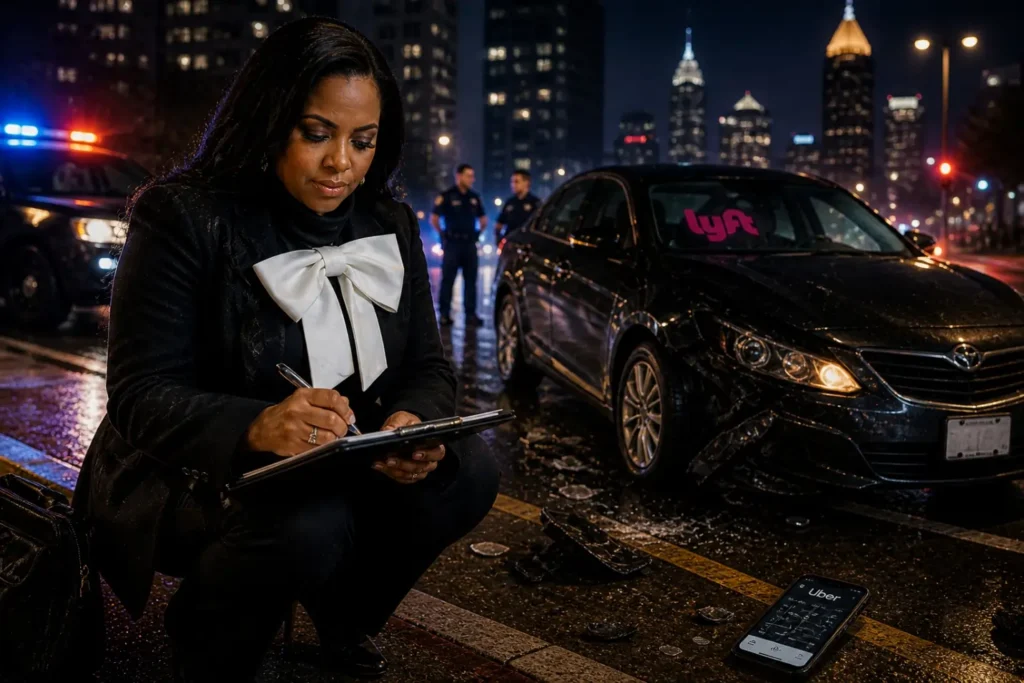
When an Atlanta Uber or Lyft driver causes a serious crash and turns out to have a dangerous driving record, prior violent conduct, or other red flags the company should have caught, victims may have a direct claim against the rideshare company itself for negligent hiring in Atlanta. These claims sit alongside the standard rideshare insurance claim and can unlock additional defendants, additional coverage, and additional accountability when the facts justify it.
Most Atlanta Rideshare Accident Victims Never Hear These Two Words
When an Uber or Lyft passenger is injured in metro Atlanta, the conversation almost always starts and stops with the rideshare company’s third-party insurance: a $1 million liability policy when the driver is on a trip, lower coverage between rides, and even less when the app is off. Most cases are handled inside that framework.
But there is a separate legal theory that gets quietly avoided by under-resourced firms and aggressively contested by Uber and Lyft: rideshare negligent hiring in Atlanta. When the rideshare company itself failed to properly vet, screen, or supervise the driver who hurt you, the company can be on the hook directly, not just through its insurance pool.
That distinction matters. It can change the defendants in the case, the available coverage, and the leverage at the negotiating table.
What Negligent Hiring Means Under Georgia Law
Georgia recognizes negligent hiring, retention, and supervision as separate causes of action against an employer. To win a negligent hiring claim against Uber, Lyft, or any rideshare platform, a victim generally must show:
- The rideshare company hired or retained the driver
- The driver had qualities or a history that made them unfit to drive passengers
- The company knew or, with reasonable care, should have known about those qualities
- The company’s failure to act on that information was a direct cause of the injury
- The injury was a foreseeable consequence of putting that driver behind the wheel
Georgia courts have applied these principles in a wide range of employment contexts. Rideshare cases are still relatively new, but the underlying doctrine is well established.
The argument from Uber and Lyft is usually that drivers are independent contractors, not employees, and that this insulates the company from negligent hiring claims. Atlanta rideshare lawyers regularly push back on that argument, and Georgia courts have shown a willingness to look past the contractor label when the company controls hiring decisions, sets standards, and benefits financially from the driver’s work.
The negligent hiring framework also applies when a rideshare company’s failure to properly screen drivers contributes to drunk or impaired rideshare driver accidents in Atlanta, where the driver’s known history of substance issues should have disqualified them from operating on the platform.
When Atlanta Negligent Hiring Claims Get Real Traction
Not every rideshare accident is a negligent hiring case. The fact pattern usually has to involve something the company should have spotted in its background check process.
Driving record red flags. Multiple recent moving violations, prior DUIs, a suspended license, or a history of at-fault crashes can all support a negligent hiring claim.
Criminal history red flags. Violent crimes, assaults, sexual offenses, or other conduct that bears on passenger safety. This is especially relevant in cases involving driver assaults on passengers.
Failure to verify identity or licensing. Cases where the driver was not actually authorized to drive on the platform, was driving under someone else’s account, or had a fake or expired license.
Retention after complaints. When prior passengers reported the driver for unsafe driving, intoxication, or aggressive behavior, and the platform took no meaningful action.
Inadequate background check vendors. Atlanta rideshare cases have explored whether the third-party background check services Uber and Lyft use are deep enough to catch what reasonable diligence would catch.
When any of these elements are present, the case stops being just about a single driver’s mistake and becomes a corporate accountability case.
Why This Matters for Atlanta Rideshare Passengers
Atlanta is one of the most active rideshare markets in the Southeast. Hartsfield-Jackson, Mercedes-Benz Stadium, State Farm Arena, the Beltline, Buckhead, Midtown, and the I-85 / I-75 / I-20 corridors generate massive rideshare volume around the clock. The more drivers a platform onboards in Atlanta, the more important rigorous screening becomes.
When a screening process fails, the consequences land on Atlanta passengers, pedestrians, and other drivers. A direct negligent hiring claim is one of the few legal tools that pushes the platform itself to take responsibility, not just the individual driver.
It also creates leverage. Insurance adjusters know that a viable negligent hiring claim against the rideshare company opens up defenses, exhibits, and risk that go far beyond a typical car accident case.
How a Negligent Hiring Claim Stacks With the Standard Rideshare Insurance Claim
In most Atlanta rideshare cases, victims pursue the available rideshare insurance coverage:
- Up to $1 million in liability coverage when the driver is on an active trip
- Contingent liability coverage when the driver is logged in and waiting for a ride
- Personal coverage when the driver is offline
A negligent hiring claim can be filed alongside that, naming the rideshare company itself as a defendant. The result is a case with multiple legal theories, multiple potential defendants, and stronger leverage than the standard claim alone.
The exact mix depends on the facts. A skilled rideshare accident lawyer in Atlanta evaluates whether the negligent hiring claim is supported by the evidence before adding it.
What Evidence Drives a Strong Negligent Hiring Case
These cases are built on documents and data, not just the crash itself.
- The driver’s full motor vehicle record (MVR), including out-of-state history
- Criminal background checks the platform did or did not run
- The driver’s complete account history with Uber or Lyft, including suspensions and reinstatements
- Prior passenger complaints, ratings, and safety reports
- The platform’s hiring and screening policies in effect at the time
- Internal communications about driver risk and screening standards
Much of this evidence is held by Uber, Lyft, or their background check vendors. Aggressive discovery is the only way to get it.
What To Do After an Atlanta Rideshare Accident
If you were injured as a passenger, pedestrian, or other driver in a crash involving an Uber or Lyft anywhere in Fulton, DeKalb, Cobb, Gwinnett, or Clayton County:
- Get medical attention immediately and follow all treatment.
- Take screenshots of your ride history in the Uber or Lyft app, including driver name and vehicle.
- Photograph the scene, vehicles, and visible injuries.
- Get a copy of the police report and the names of all witnesses.
- Avoid recorded statements with any insurer until you have spoken with a lawyer.
- Call a rideshare accident lawyer in Atlanta who has handled negligent hiring claims before.
How KP Law Group Approaches Atlanta Rideshare Cases
At KP Law Group, Atlanta rideshare cases are evaluated for every available theory of liability, including negligent hiring, negligent retention, and corporate-level negligence by Uber and Lyft. We pursue the rideshare company directly when the facts support it.
Founding attorney Kristen Pitts leads the team’s rideshare practice, with experience handling cases across metro Atlanta and surrounding counties.
Frequently Asked Questions
Q: Can I sue Uber or Lyft directly after an Atlanta accident?
A: Sometimes, yes. Direct claims against the rideshare company often involve negligent hiring, negligent retention, or claims tied to the platform’s safety practices. The standard rideshare insurance claim is separate and usually pursued in parallel.
Q: What is rideshare negligent hiring in Atlanta?
A: Negligent hiring is a legal claim that the rideshare company hired or kept on a driver it knew or should have known was unfit to safely transport passengers. Common red flags include a poor driving record, a violent criminal history, or unaddressed complaints from prior riders.
Q: Doesn’t the independent contractor label protect Uber and Lyft from these claims?
A: Uber and Lyft argue it does. Atlanta rideshare lawyers regularly challenge that position, and Georgia courts have shown willingness to look past the contractor label depending on the facts. The defense is real, but it is not absolute.
Q: How much insurance applies in an Atlanta rideshare accident?
A: Up to $1 million in liability coverage applies when the driver is on an active trip. Reduced contingent coverage applies when the driver is logged in but waiting for a ride. Personal auto policies apply when the driver is offline.
Q: How long do I have to file a rideshare accident claim in Georgia?
A: Georgia’s general personal injury statute of limitations is two years from the date of the crash under OCGA 9-3-33. Some claims have shorter notice requirements, so consulting an Atlanta rideshare lawyer early is important.
Call to Action
If you were hurt in an Uber or Lyft accident in Atlanta and the driver should never have been behind the wheel, you may have more options than the rideshare company wants you to know about.
Call KP Law Group at 404-551-4727 for a free Fierce and Fearless Case Review.